Without having a solid handle on how the virus spread, we were left to quarantine our mail, wipe down any packages with disinfectant, and wash our produce with soap and water. According to a new study published in Royal Society Open Science, humans aren’t the only primates who take extreme precautions during viral outbreaks. In 2020, a Texas primate sanctuary was dealing with its own mini-pandemic.
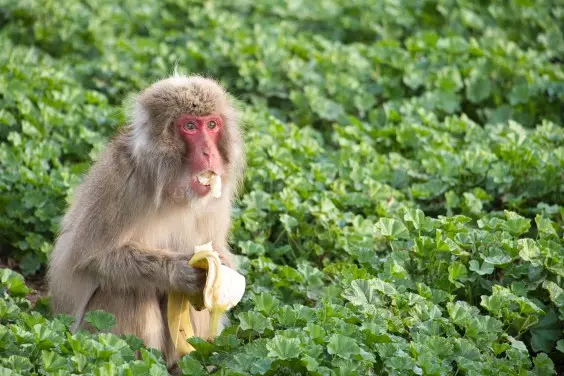
Simian retrovirus Type II, a virus that causes an immune deficiency similar to AIDS in primates, swept through three of four groups of Japanese macaques housed at the sanctuary. Bad news for the monkeys, but good news for cognitive scientists from the University of California San Diego. They used the natural experiment to investigate how exposure to the virus changed the behaviors of exposed groups versus the unexposed one.
Read more: “How a Rare Disease Could Yield a Pandemic Drug” The team tested 55 of the macaques, offering them a choice between fruit placed on wood (or a kitchen sponge) and fruit placed on a surface covered with real macaque feces trapped under a layer of epoxy. While this might seem like an obvious choice even without a viral outbreak, previous research has shown macaques will still eat feces-contaminated food, provided it’s rewarding enough. They found that macaques in the unexposed group ate the contaminated-appearing fruit in 79 percent of trials.
In contrast, macaques from the groups that had firsthand experience with the virus only picked the feces food in 47 percent of trials—whether they had been infected or not. According to the team, this suggests that it was the experience of the outbreak itself, rather than any contact with the actual virus, that caused the behavioral change. In fact, simian retrovirus Type II is transmitted by bites and scratches, not contaminated feces or food.
In other words, living through an outbreak was enough to raise their general caution level. The team says these findings offer clues to the evolutionary origins of a very primal human emotion: disgust. Disgust protects us from exposure to pathogens by making us recoil from vectors like feces, vomit, worm-ridden food, etc. (If even the mere mention of them ruins your appetite, it’s a testament to how strong the emotion is.) But while disgust is powerful and instinctive, it’s also shaped by our early experiences (e.g., you may have an intense aversion to the first food you remember throwing up).
The same, apparently, is true for other primates. In a second study, the team performed the same experiment using macaques with different rearing backgrounds. They found that the pet monkeys who grew up living with humans were more likely to indulge in contaminated food compared to those born in sanctuaries and raised by macaque mothers.
Extract — continue reading at the source.