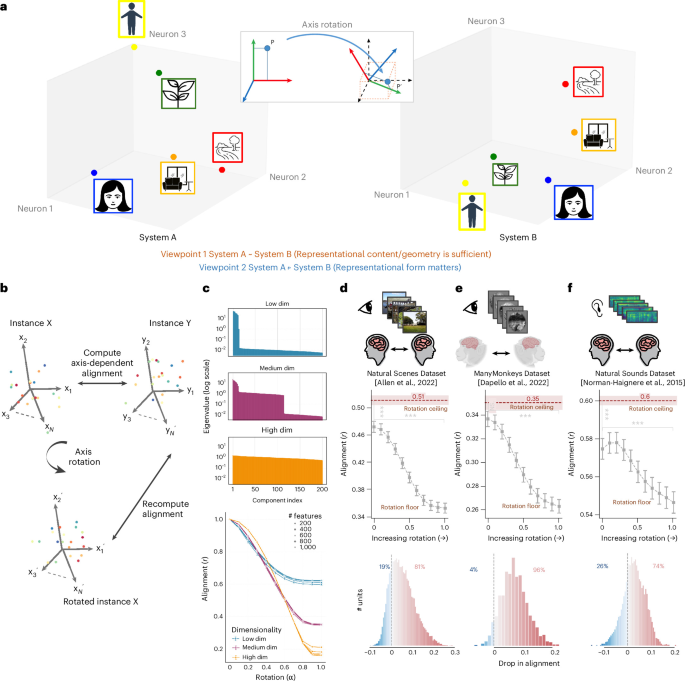
Recent work emphasizes the geometry and information content of population codes, using measures that are blind to the native tunings (or ‘axes’) of neural responses. But might these representational axes matter, with some privileged systematically over others? We developed methods to test for alignment of neural tuning across brains and deep convolutional neural networks (DCNNs).
Across both vision and audition, both brains and DCNNs consistently favoured certain axes for representing the natural world. Moreover, the representational axes of DCNNs trained on natural inputs were aligned to those in perceptual cortices, such that axis-sensitive model–brain similarity metrics better differentiated competing models of biological sensory systems. We further show that coding schemes that privilege certain axes can facilitate task performance, reduce downstream wiring costs and improve generalization.
These results motivate a new framework for understanding neural tuning in biological and artificial networks and its computational benefits. This is a preview of subscription content, access via your institution Access Nature and 54 other Nature Portfolio journals Get Nature+, our best-value online-access subscription Receive 12 digital issues and online access to articles Prices may be subject to local taxes which are calculated during checkout This study only uses publicly available models and datasets. The code used in this study is available in OSF at https://osf.io/xdc5y/ (ref. 113).
Two views on the cognitive brain. Neurosci. 22, 359–371 (2021). Saxena, S. & Cunningham, J.
Towards the neural population doctrine. Neurobiol. 55, 103–111 (2019). Cortical population activity within a preserved neural manifold underlies multiple motor behaviors.
Article PubMed PubMed Central Google Scholar Cunningham, J. Dimensionality reduction for large-scale neural recordings. Neurosci. 17, 1500–1509 (2014).
Extract — continue reading at the source.