Obsessive–compulsive disorder (OCD) remains difficult to treat, and evidence indicates that social dysfunction, common across obsessive–compulsive and related disorders, is an under-recognized clinical burden. SAPAP3 knockout (KO) mice, a well-established model of compulsive behavior, exhibit social abnormalities, suggesting broader disruptions in circuits relevant to social cognition. Here, we investigated whether psilocybin, a serotonergic psychedelic with emerging therapeutic potential, can restore social behavior in SAPAP3 KO mice and whether behavioral rescue is associated with modulation of neural activity.
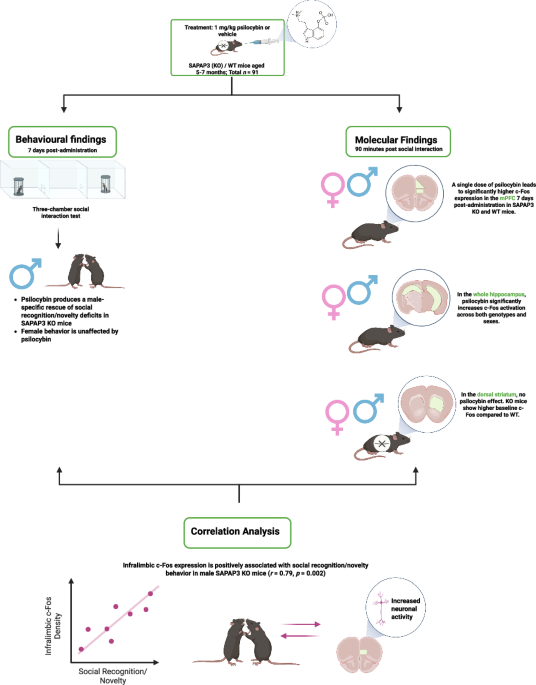
Male and female SAPAP3 KO mice and wild-type littermates received a 1 mg/kg psilocybin intraperitoneal injection, and social behavior was assessed seven days later using the three-chamber social interaction test. Psilocybin produced a male-specific, enduring restoration of novel-mouse-directed investigation during social recognition/novelty testing. Immunohistochemical quantification of c-Fos revealed that psilocybin increased neural activation in the medial prefrontal cortex and hippocampus regardless of genotype.
Only infralimbic c-Fos levels correlated with improved social recognition/novelty behavior in male SAPAP3 KO mice, identifying infralimbic recruitment as a key correlate of therapeutic rescue. Psilocybin did not alter c-Fos in the nucleus accumbens, basolateral amygdala, or dorsal striatum. These findings demonstrate that psilocybin exerts domain-specific, enduring effects on social cognition in an established model of compulsive-like behavior, potentially involving prefrontal plasticity-related mechanisms.
Given the lack of pharmacological treatments targeting social dysfunction in OCD and associated neuropsychiatric disorders, these results highlight psilocybin as a promising candidate for improving social-cognitive outcomes in disorders characterized by repetitive behaviors and social impairment. Obsessive–compulsive disorder (OCD) is a chronic, disabling condition affecting 1–3% of the population [1]. First-line treatments such as exposure and response prevention and selective serotonin reuptake inhibitors (SSRIs) remain only partly effective, with high non-response and dropout rates [2, 3].
Additionally, SSRIs have significant side-effects and can lead to dependence and withdrawal-like symptoms [4]. These limitations underscore the need for novel pharmacological therapeutic options. Cortico-striatal circuit dysfunction is strongly implicated in the pathophysiology of clinical OCD and related disorders (OCRDs) [5].
SAPAP3 is a key postsynaptic scaffolding protein enriched at cortico-striatal glutamatergic synapses [6]. Loss of SAPAP3 disrupts α-amino-3-hydroxy-5-methyl-4-isoxazolepropionic acid (AMPA), N-methyl-D-aspartate (NMDA), and metabotropic glutamate receptor (mGluR) signaling, producing excessive compulsive-like grooming behavior [7,8,9]. These synaptic and behavioral phenotypes are causally linked to cortico-striatal dysfunction, as striatal re-expression of SAPAP3 rescues both synaptic abnormalities and excessive grooming, while cortico-striatal circuit modulation reduces compulsive-like grooming [7, 10].
Extract — continue reading at the source.


