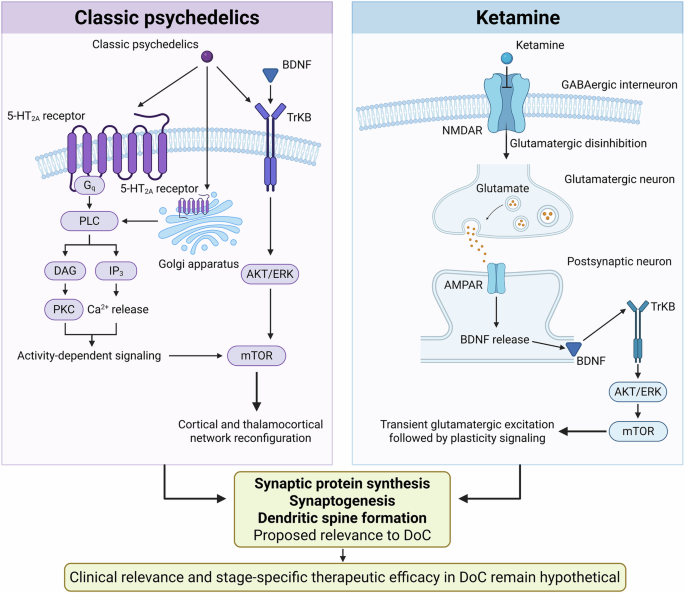
Disorders of consciousness (DoC), including coma, unresponsive wakefulness syndrome (also known as vegetative state), and minimally conscious state, represent profound disruptions in awareness and responsiveness due to severe brain injury, with limited therapeutic options available. Recent advancements in neuroimaging have improved our ability to detect residual brain activity in DoC patients, but effective interventions remain elusive. Psychedelics like psilocybin, lysergic acid diethylamide (LSD), and N,N-dimethyltryptamine (DMT), which modulate brain network dynamics and enhance neural plasticity, have emerged as candidate pharmacological probes and potential therapeutic strategies for DoC.
These substances primarily exert their effects through serotonin 2 A (5-HT2A) receptor agonism, inducing widespread changes in cortical activity and connectivity, in contrast to the reduced connectivity typically seen in DoC. The entropic brain hypothesis suggests that psychedelics increase neural entropy, potentially fostering more flexible brain states that could facilitate recovery in DoC patients by restoring communication between isolated brain regions. While direct human feasibility evidence has recently emerged from initial pilot and case studies, controlled clinical evidence demonstrating sustained restoration of consciousness remains absent.
Consequently, key challenges such as determining optimal dosing, safety, and ethical considerations must be addressed before clinical application. This perspective reviews the neurobiological mechanisms of psychedelics, their potential for treating DoC, and the clinical and methodological hurdles to overcome, emphasizing the need for interdisciplinary research to translate these ideas into effective therapies. Moreover, this exploration contributes to a deeper understanding of consciousness and its modulation through pharmacological means.
This is a preview of subscription content, access via your institution Receive 12 print issues and online access Prices may be subject to local taxes which are calculated during checkout Data sharing is not applicable to this article as no datasets were generated or analysed during the current study. Zhang MY, Wang YB, Gao TM, Wang XH. Psychedelics and consciousness: expanding the horizons of mind and therapy.
Golden K, Bodien YG, Giacino JT. Disorders of consciousness classification and taxonomy. Phys Med Rehabil Clin N Am. 2024;35:15–33.
Chennu S, Annen J, Wannez S, Thibaut A, Chatelle C, Cassoi H, et al. Brain networks predict metabolism, diagnosis and prognosis at the bedside in disorders of consciousness. Kondziella D, Friberg CK, Frokjaer VG, Fabricius M, Moller K.
Extract — continue reading at the source.


