75,000 headwords, 289,000 entries: what Azerbaijanis actually want explained
Over fourteen years people have created more than 75,000 headwords in this dictionary. Seven in ten are not words at all — they are sentences, situations, feelings with no name. And the single most-defined 'word' appears in no dictionary anywhere.
An official dictionary is a closed list: somebody decides which words belong to a language, and the rest stay outside. An open dictionary inverts that — the people decide what needs explaining. The difference can be measured, because this site holds fourteen years of it.
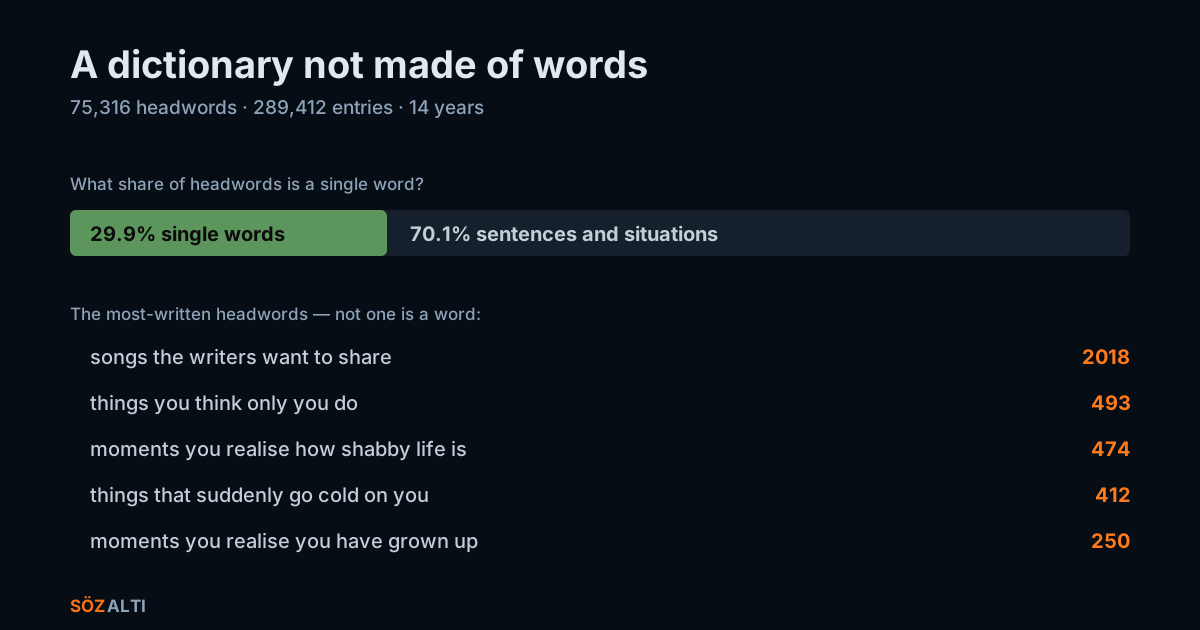
The numbers: 75,316 headwords, 289,412 published entries.
The first result is unexpected. Only 29.9% of headwords are single words. The remaining 70.1% are multi-word constructions — sentences, questions, descriptions of a situation. This is an archive called a dictionary that is largely not made of words.
The second speaks more plainly. Look at the headwords with the most entries: 'songs the writers want to share' (2,018 entries), 'things you think only you do' (493), 'moments when you realise how shabby life is' (474), 'things that suddenly go cold on you' (412), 'moments when a person realises they have grown up' (250).
There is not one word in that list. They are all situations.
Note that these are not arbitrary sentences. Each describes a specific, recognisable feeling — one that Azerbaijani has no single word for. 'Things you think only you do' has no name in English either. Somebody wrote a headword where no word existed, and then 493 people arrived to say: me too.
That changes what the dictionary is for. You consult an official dictionary to learn what a word means. You consult an open one to check that a feeling is not only yours.
A third number completes the picture: 52.1% of headwords that have any entry have exactly one. More than half were opened once, written in once, and left. That is not failure — it is the long tail of a language. Not every feeling gets 493 people; some get one, and for that one person the headword was worth creating.
There is something here for linguistics. We usually imagine word formation as a long process: a word appears, spreads, enters the dictionary. This archive shows the stage before that — the moment when the feeling exists and the word does not yet. People fill the gap with a sentence, because there is no other way to do it.
Some languages have words for such moments. Portuguese has saudade, German Schadenfreude, Japanese tsundoku. Those were sentences once too, before they compressed into a word.
Most of these 75,316 headwords will never become words. But the chance that one of them does is real — and that moment gets recorded in archives like this one, not in academic dictionaries.
An official dictionary tells you what a language is. An archive like this shows you what a language is missing. The second says more.