The world's most widely understood word started as a newspaper joke
In March 1839 a Boston editor wrote “oll korrect” and abbreviated it: O.K. It was a joke. Two centuries later those two letters are used in nearly every language — and almost no one remembers where they came from.
You said it today. In a message, a nod, a phone call. Two letters that mean “fine, agreed, understood” and work in Baku, in Tokyo, in Lagos. Few words are this universal. And it began as a printed joke.
Boston in the 1830s. Among newspaper editors there was a fad: deliberately misspelled abbreviations, as humour. “K.G.” for “know go” (no go), “K.Y.” for “know yuse” (no use), “N.S.M.J.” for “’nough said ’mong jintlemen”.
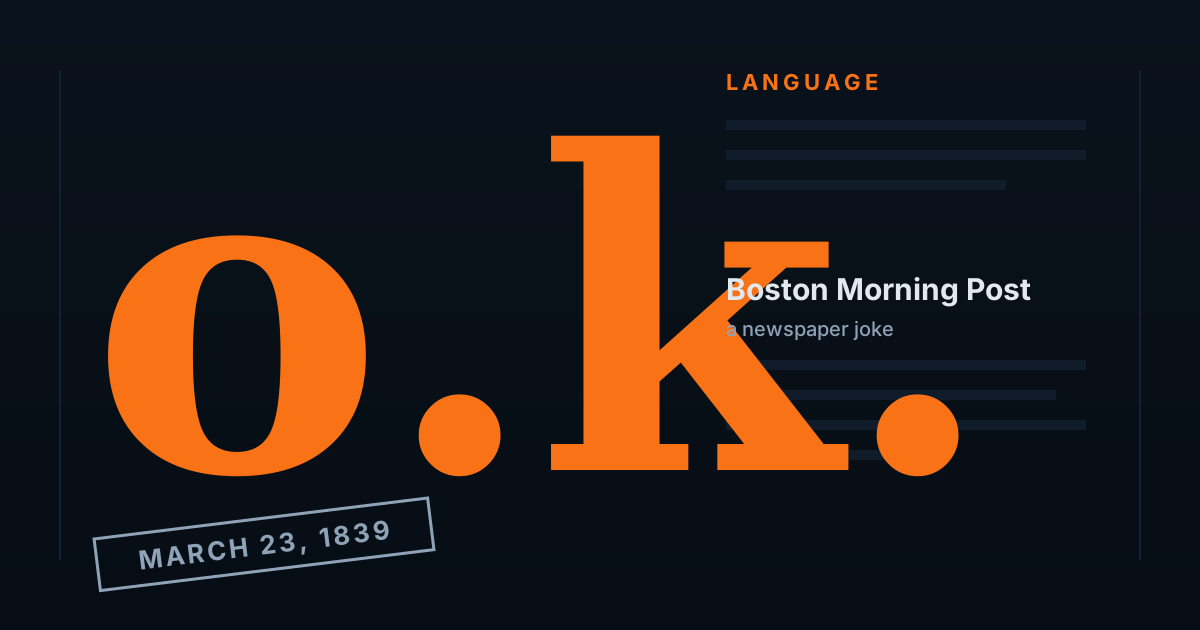
23 March 1839. The Boston Morning Post, editor Charles Gordon Greene, in a small item mocking a rival group, writes that their “contribution box” and so on would be “o.k. — oll korrect.” Here “o.k.” stands for “oll korrect” — a mock-phonetic misspelling of “all correct.” A throwaway line.
It should have died like the rest. It didn't — because of an election.
1840. Martin Van Buren is running for a second term. He was born in Kinderhook, New York; supporters called him “Old Kinderhook.” Clubs formed under the name “O.K. Club.” Suddenly the two letters were on banners, in chants, in every paper — the two meanings feeding each other.
Van Buren lost. But “O.K.” outlived the campaign that spread it. By the 1860s it was in telegraph operators' shorthand (“received”), stamped on shipping crates, in Civil War dispatches.
Because the origin was a joke nobody recorded properly, the vacuum filled with theories. Choctaw “okeh” (approved). Greek “óla kalá” (all good). Scots “och aye.” The Haitian port of Aux Cayes, known for good rum. A baker named Orrin Kendall stamping his biscuits. Each sounds plausible. None is documented.
But the mystery was actually solved. Between 1963 and 1964, the Columbia etymologist Allen Walker Read published a series of articles tracing every early printed use back to that 1839 item. He laid out the abbreviation fad, the election boost, and dismantled the rival stories one by one. It is one of the most thorough origin-hunts in the history of English.
What makes “O.K.” strange is not just the joke — it is that it filled a gap nobody knew was there. English had no short, neutral, tone-free way to say “received, no objection.” “Yes” is too eager, “fine” slightly cold. O.K. is a word with almost no feeling in it, which is exactly why it travels: a Japanese text, an air-traffic readback, a nod between strangers.
Next time you type it, you are repeating a Boston editor's 187-year-old pun about a word he misspelled on purpose. It stuck because it was useful, not because it was right. Most of language works that way.