143 days: how Azerbaijan lost a letter and took it back
When the new alphabet was adopted in December 1991, the letter ə was not in it. It came back 143 days later. That decision was the technically inconvenient option — and thirty years on it still breaks software.
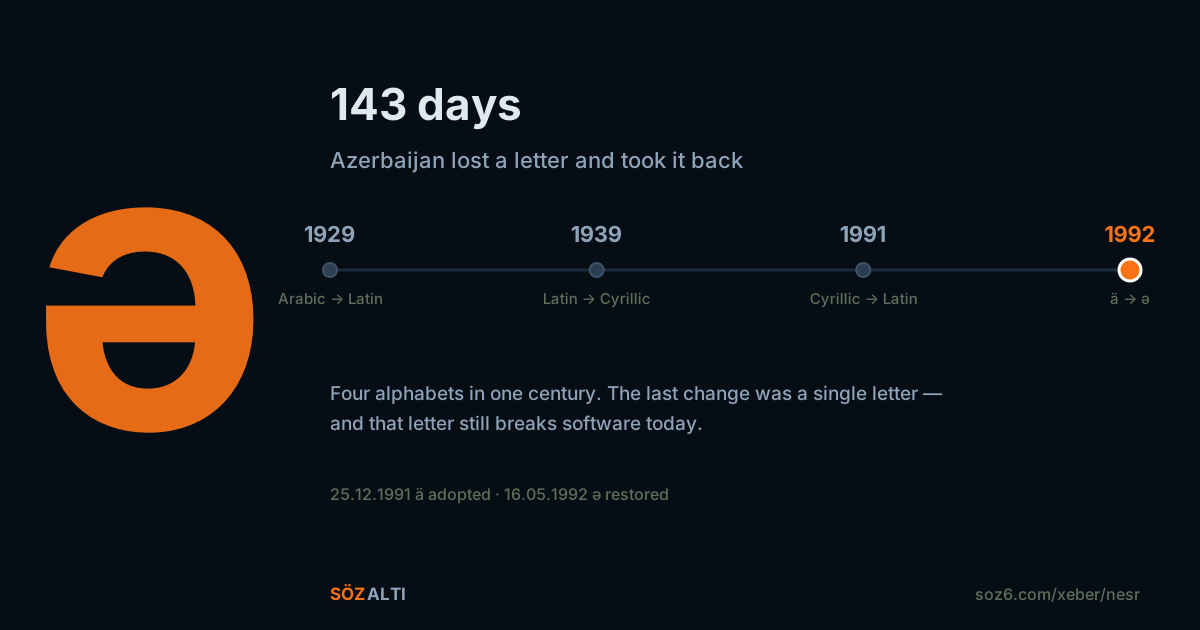
Over a single century, Azerbaijanis had to learn to read four times. Arabic script until 1929, then Latin, then Cyrillic on Stalin's orders from 1939, then Latin again from 1991. Each change left a generation unable to read its own grandparents' letters.
Inside the fourth change hides a fifth, much smaller one — and it is the interesting one.
The Latin alphabet adopted on 25 December 1991 used ä — a-umlaut — for the /æ/ sound. It was a sensible choice: ä exists on Turkish keyboards, in German, and in virtually every computer encoding of the period. It was the practical option.
On 16 May 1992 it was dropped. In its place came the historic ə — the schwa. Between the two dates: 143 days.
The reason was not technical, because technically ə is the worse option. At the time it was simply absent from most fonts and character sets. The reason was something else: q, x and ə are the marks that separate written Azerbaijani from written Turkish. Adopt ä, and Azerbaijani becomes a variant of Turkish orthography. Keep ə, and it stays its own thing.
In 1992 a choice was made between convenience and identity, and identity won. The price was one letter.
Thirty-four years later that bill is still being paid, daily. This site's own machinery is the evidence.
ImageMagick, converting Azerbaijani text into an image, simply drops the ə, because the font it picks does not contain the glyph. It gives no warning; it leaves a gap. "Dünyanın xəbər günü" comes out as "Dünyanın x b r günü". Nothing appears in any log until a human notices.
MySQL's pattern matching treats ı and i as the same letter, so every English "i" can be scored as Azerbaijani text. That once caused 1,679 articles to be marked as corrupted when every one of them was fine.
PHP does it too: mb_strtolower("SÖZALTI") returns "sözalti", not "sözaltı". The dotless ı and the dotted i are two separate characters in Unicode, and most libraries do not know it.
These are not small annoyances so much as a pattern. The world's software is written for the English alphabet and then 'internationalised'. Smaller languages are always the addition that comes afterwards, and they are always what breaks first.
The 1992 decision was still right. Had the convenient option won, nothing would break today — Azerbaijani writing would simply have lost a mark of its own, and gained nothing in exchange.
Sometimes a letter is not only a letter. Sometimes it is the one sign that says you are a separate language — and every time some library mishandles it, that is proof the sign is still doing its job.