You cannot tickle yourself — and that explains how you see reality
A small oddity: the same touch tickles from someone else's hand and not from your own. Follow that detail and you arrive at the biggest idea in modern neuroscience — the brain does not receive the world, it predicts it.
You can test this now. Tickle your own palm. Nothing. Have somebody else do exactly the same thing and it is unbearable. Same movement, same skin, same nerves. The only difference is whose hand it is.
In 1998 in London, Sarah-Jayne Blakemore, Daniel Wolpert and Chris Frith put this under a brain scanner. What they found: before you move, the cerebellum computes what that movement will feel like and sends the prediction to the sensory areas so the incoming signal is damped in advance. By the time your own touch arrives, it is already expected — and expected things are felt weakly.
You feel your own touch less because your brain already knew about it.
Now take that logic out of tickling and apply it to perception itself. That is the road neuroscience has travelled for twenty years.
The old picture went like this: signal arrives from the world, lands on the eye, travels to the brain, the brain processes it, an image appears. Like a camera. That picture is simply wrong.
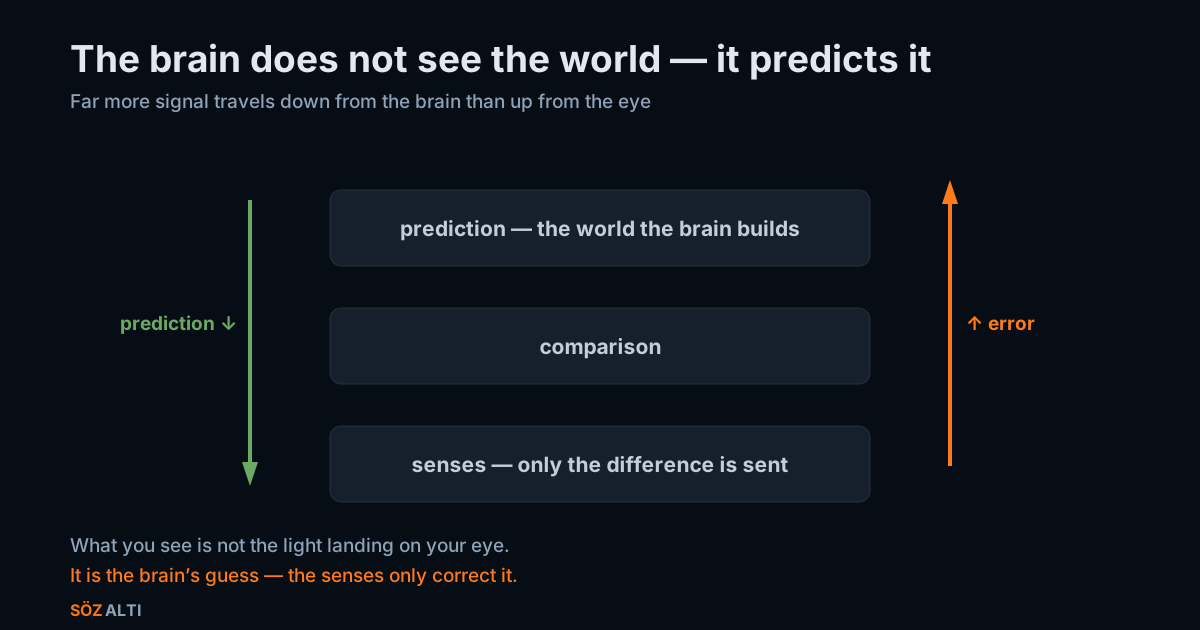
The anatomy says so directly. There are more connections running top-down — from brain to senses — than bottom-up from eye to brain. If the brain were merely receiving data, the cables would run the other way.
So the current model is inverted. The brain is constantly predicting what the world is about to be, and sends that prediction downward. The senses do not send the world up — they report only where the prediction was wrong. What travels up is not a picture. It is a correction.
The neuroscientist Anil Seth calls this a 'controlled hallucination'. What you see is the brain's best hypothesis; the senses are what keeps it fenced in. The sharpest consequence of that description: the difference between healthy perception and hallucination is not a difference in kind. Both are images the brain constructs. In one the senses still hold the leash, and in the other they have let go.
The model explains a pile of small oddities at once. Why your recorded voice sounds like a stranger's. Why a stationary car feels like it is moving when the one beside it pulls away. Why optical illusions keep working even after you know the truth — because the prediction is assembled below the level of your agreement.
And here is the part I keep turning over.
Artificial intelligence arrived at the same principle from a completely different direction. Language models today learn by predicting the next word: predict, measure the error, adjust the weights, repeat. Nobody set out to copy a brain. It simply turned out that predicting and then correcting the error is a method that works for learning a world.
Nature had found the same answer over four hundred million years.
None of this diminishes anyone. The opposite. Inside your skull there is no light, no sound, no colour — it is entirely dark and entirely silent. A kilo and a half of tissue sits in that darkness and constructs a world accurate enough that you can live in it, hunt in it, fall in love in it, and read this sentence in it.
The room you are looking at is not the light landing on your eye. It is your brain's best guess — and so far, it is not wrong by much.