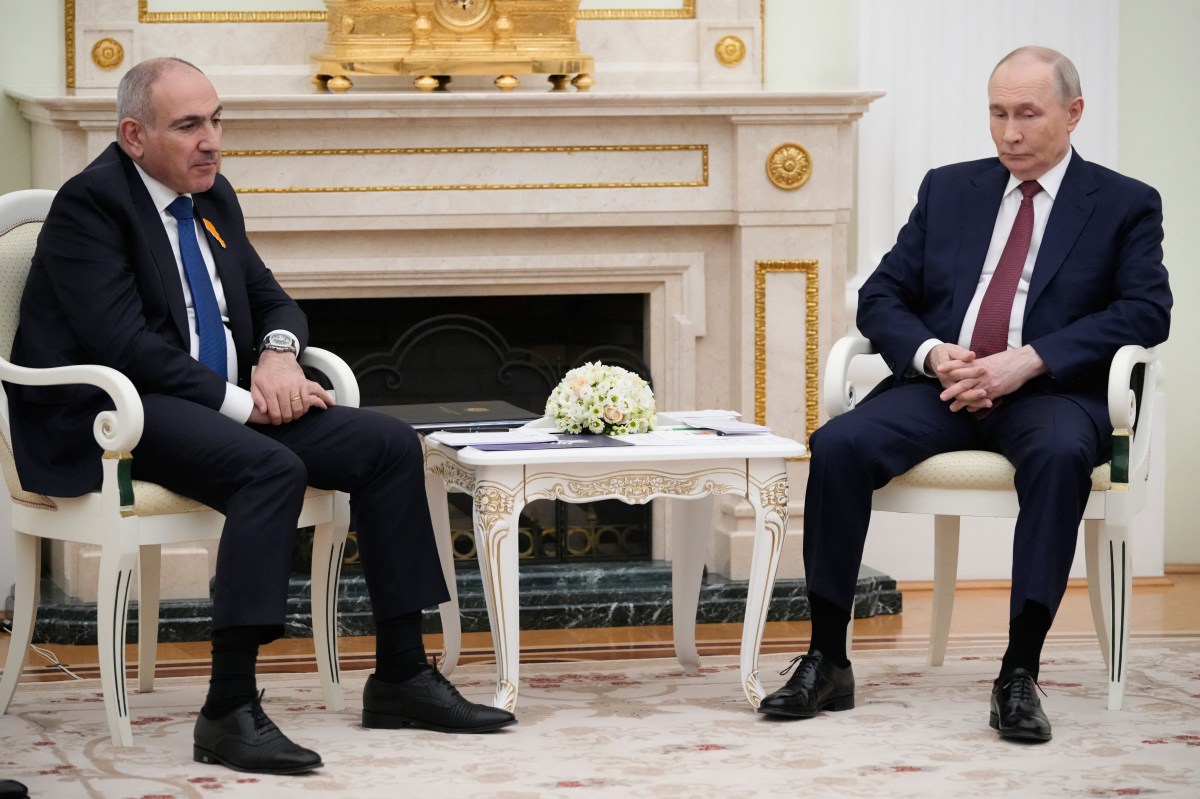
A founding member of Russia's post-Cold War answer to the U.S.-led NATO alliance is moving forward with plans to exit the bloc, putting pressure on Moscow's historic influence at a crossroads of Europe and Asia. Speaking before parliament on Monday, Armenian Prime Minister Nikol Pashinyan reiterated his February 2024 decision to freeze cooperation with the Collective Security Treaty Organization (CSTO) after its perceived failure to aid his country in recent conflicts with Azerbaijan and indicated he would support any move by the six-nation coalition to expel his country. "I can say with certainty that we will not activate our work in the CSTO, we will not activate it," Pashinyan said.
"And I know there are discussions in the CSTO and in the organization." "The statute provides for such a thing, the country can be expelled from the organization," he added. "I will be very pleased if the organization decides to expel the Republic of Armenia from the Collective Security Treaty Organization. At least it will free us from the dilemma of not leaving." In response, Kremlin spokesperson Dmitry Peskov told reporters in Moscow that "if Yerevan no longer needs to be a member of such an important organization for ensuring regional security to serve its national interests, then it is free to take the appropriate decision and leave this organization." Richard Giragosian, director of the Regional Studies Center in Yerevan, described the language on Armenia's part as "rather belated" as the CSTO "has proven to be an unreliable security provider" in the face of "attacks and incursions of Armenian sovereign territory by Azerbaijan." "Although that crisis with Azerbaijan has largely been superseded by unprecedented progress in diplomatic negotiations between Armenia and Azerbaijan, the Russian-dominated CSTO now stands out as a dead end for Armenian security," Giragosian told Newsweek.
"Yet the Armenian leadership is both prudent and cautious in not unnecessarily provoking an over-reaction from Russia," Giragosian said. "Hence, the real leverage from Armenia has been from suspending its contribution to the CSTO rather than exiting the 'empty alliance' that now defines the CSTO." Russia's consolidation of influence over Armenia dates back nearly 200 years to a postwar 1828 treaty with Qajar Iran that saw much of the modern territory of the South Caucasian nation incorporated into the Russian Empire, with Russia portraying itself as a protector of Armenian interests against rival Ottoman and Persian aims. Armenia briefly gained self-rule in 1918 after the Russian Civil War but was incorporated alongside neighboring Azerbaijan and Georgia into the Soviet Union in 1920.
Armenia once again secured independence in 1991 after the collapse of the Soviet Union. However, Armenia retained close military ties with Russia, joining the newly established Collective Security Treaty—the precursor to the CSTO—the following year as conflict intensified with Azerbaijan over the disputed Nagorno-Karabakh territory, with Yerevan emerging as the victor. Azerbaijan and Georgia joined the Collective Security Treaty in 1993 but later withdrew in 1999 amid negotiations toward extending the alliance into what would become the CSTO in 2002.
Uzbekistan also joined the Collective Security Treaty but declined to sign its extension in 1999 and went on to join the CSTO in 2006 until leaving in 2012. Nagorno-Karabakh and the establishment of the Armenia-backed Artsakh Republic on internationally recognized Azerbaijani territory remained a major source of tensions between Yerevan and Baku, leading to several skirmishes over the years. A series of conflicts in 2020, 2022 and 2023 ultimately led to Azerbaijan dismantling the separatist presence and serious casualties among both Armenian and Armenian-backed forces.
Russa deployed thousands of peacekeepers but its hesitance to intervene in favor of Armenia in response to Azerbaijani attacks on Armenian territory raised doubts among Armenian leadership as to the extent of Moscow's willingness and capability to safeguard the country, especially after Russia's 2022 invasion of Ukraine. In his latest remarks, Pashinyan said that relations between Yerevan and Moscow over the past two centuries have been "built on the foundation and understanding that Russia is the guarantor of the security of the Armenian people and the Armenian state." However, he said, "due to its own security challenges, the Russian Federation can at times face significant limitations in its ability to perform this role." The current CSTO alliance member states are Armenia, Belarus, Kazakhstan, Kyrgyzstan, Russia and Tajikistan. Out of these nations, only Belarus has provided direct support for Russia's war with Ukraine.
Extract — continue reading at the source.