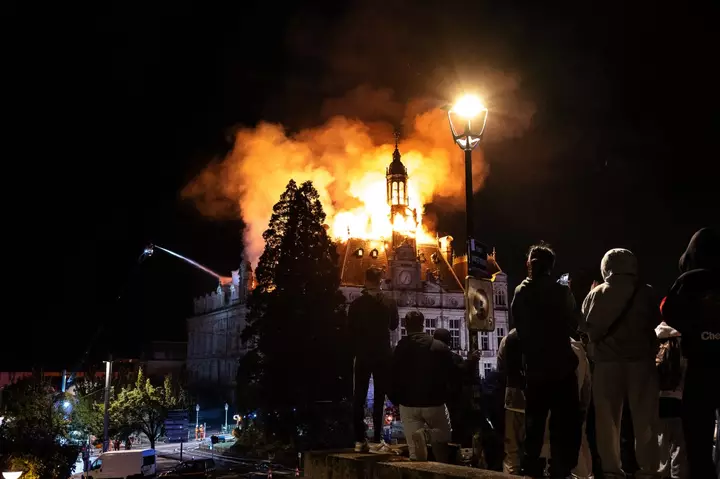
As President Donald Trump presses on with a war against Iran, another intervention that led to the death of an adversarial leader 15 years ago Tuesday looms heavily over the White House. In some ways, the chaos and conflict mismanagement that followed the slaying of Libya's Muammar el-Qaddafi in October 2011 at the hands of a rebellion backed by NATO airpower helped pave Trump's path to power. An explosion of migration across the Mediterranean to Europe, the deadly storming of a U.S. diplomatic compound in Benghazi and a swell of anti-establishment sentiments directly link the death of Qaddafi to the political triumph of Trump five years later.
But the U.S. policy missteps on Libya that then-President Barack Obama once referred to in 2016 as the "worst mistake" of his presidency now threaten to be dwarfed by an even greater imbroglio for the very same U.S. leader who campaigned against costly regime change operations abroad. "This mistake is that this is a war unlike any war not in American history, it's a war unlike any in global history," Jason Pack, host of the Disorder Podcast and geopolitical consultant who advised the Obama administration during the 2011 uprising in Libya, told Newsweek. In Libya, the limits of U.S. airpower were laid bare due to inability and unwillingness to comprehensively shape events on the ground once Qaddafi's four-decade rule had collapsed to a large-scale, well-armed insurgency.
In Iran, no comparable opposition force exists on the ground, nor have top military officials defected from the Islamic Republic. "Obviously in 2011 we were supporting a multi-million person strong, 10,000-person armed uprising," Pack said. "We happened to play the role of the air force via the no-fly zone by shooting down Gaddafi's planes and an attacking tank column." Because the war on Iran "wasn't coordinated or didn't facilitate a new Iranian uprising, it was an attempt to do something that no one has ever thought to use air power alone to do, which is to overthrow a regime," he said.
"That makes no sense." When regional Arab Spring unrest first erupted into open clashes between the government and opposition forces in Libya, Trump—already an established public figure years way from his first presidential bid—initially urged U.S. action to unseat Qaddafi "quickly" and "surgically" in February 2011. By April, however, the future U.S. president had grown skeptical of what he viewed to be Obama's ceding of key decision-making on the NATO operation to allies, particularly France. Trump also warned at the time of a situation in which "we get rid of Qaddafi, we end up with worse." It's a warning Trump has repeated more recently in an acknowledgment of a worst-case scenario in Iran, where the assassinated Supreme Leader Ayatollah Ali Khamenei was swiftly replaced by his potentially more hard-line son and an increasingly influential cadre of Islamic Revolutionary Guard Corps officials.
Trump's comments at the time proved prescient for another reason. While then-Secretary of State Hillary Clinton famously celebrated Qaddafi's grisly demise with her "We came, we saw, he died" quip, Trump saw a "disaster" unfolding after the toppling of a leader who at least "had control over the country." The September 2012 attack by Islamist militants that befell the U.S. diplomatic compound in Benghazi, killing 10 people, including Ambassador J. Christopher Stevens, marked an especially troubling episode for the Obama administration.
The backlash elicited inquiries that ultimately gave rise to an entirely new controversy in the form of an official investigation into Clinton's use of private email server for official communications. The scandal served as key fodder for Trump's attacks against Clinton as he defied the odds to become the Republican candidate and then emerge as victor against his heavily favored Democratic rival in the November 2016 election. Pack, who wrote "Libya and the Enduring Global Disorder," traced the shock electoral outcome and the associated emergence of a new populist wave across the West to trends born in the aftermath of Qaddafi's overthrow.
Extract — continue reading at the source.