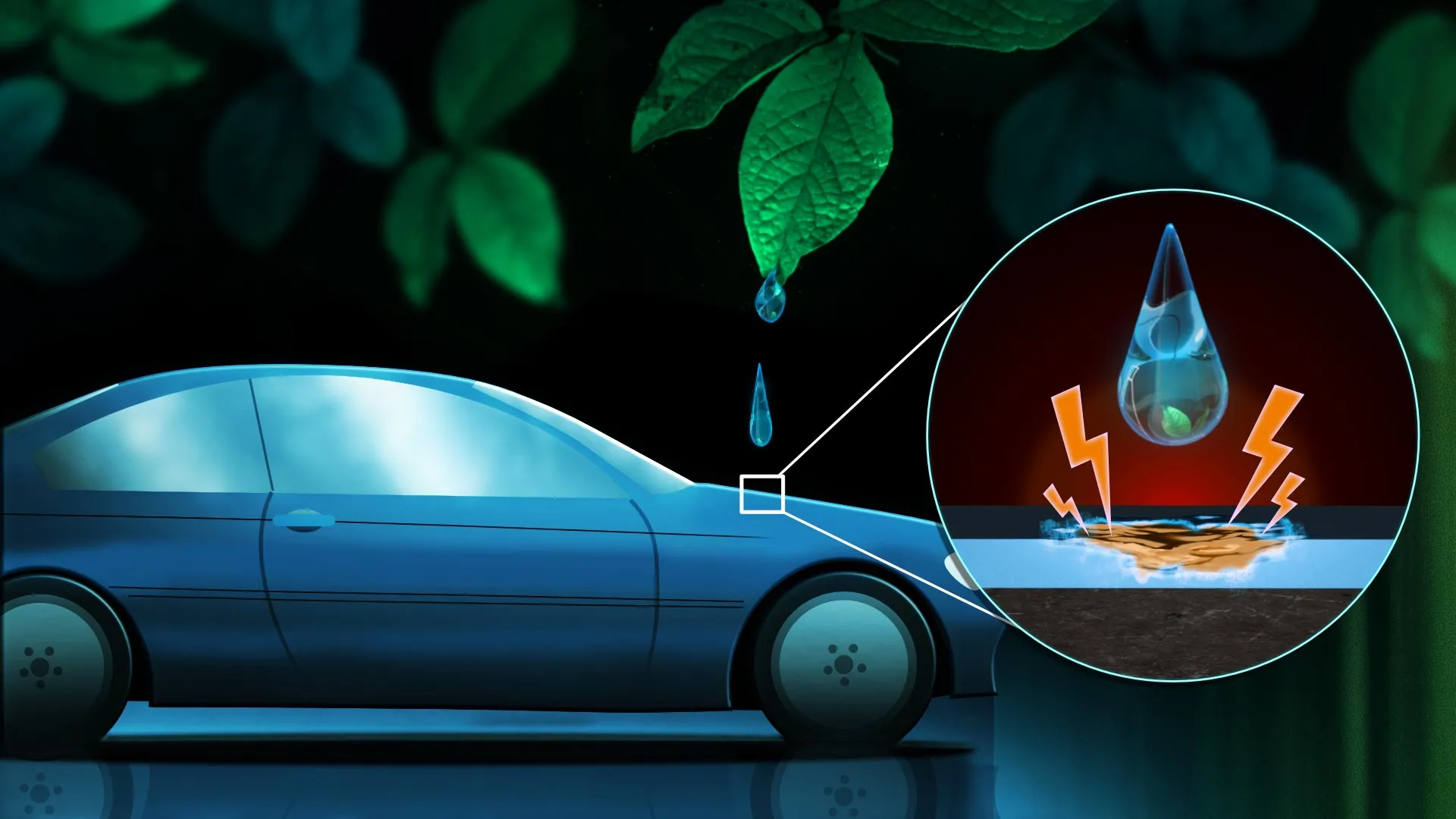
A garden fence may need a fresh coat after only a few years because weather has gradually worn the surface down. The same basic problem affects far larger structures, including the Eiffel Tower and the Golden Gate Bridge, which require extensive repainting to keep their protective coatings in good condition. Scientists have traditionally attributed this type of deterioration to two major processes.
One is mechanical stress, in which repeated contact with water droplets creates friction that slowly erodes a coating or causes pieces of it to peel away. The other is chemical damage, especially when the water contains substances such as acids or salts. Now, researchers have identified an additional mechanism that had largely escaped attention: the electrical charge carried by water droplets.
The work was led by Hans-Jürgen Butt, director at the Max Planck Institute for Polymer Research, in collaboration with researchers from the University of Bonn, South China University of Technology, MIT, and Johannes Gutenberg University Mainz. "A few years ago, we investigated the physics behind how water droplets become charged as they slide across surfaces. This is a kind of 'friction electricity' in droplets and is physically much more complex than previously assumed," says Rüdiger Berger, group leader in the "Physics at Interfaces" department.
"When such charged droplets strike a coating, they discharge locally and can puncture the layer in specific spots like a small flash of lightning -- with consequences for the coating's durability." In other words, a droplet can pick up electrical charge while moving across a surface. When it later strikes a protective coating, that charge can suddenly discharge at the point of impact, potentially damaging the material. To test how much harm these tiny electrical events could cause, the researchers began with a surface evenly covered in Teflon, a material widely known for its use on frying pans.
They repeatedly dropped uncharged water droplets onto the Teflon. Even after 3,000 impacts, microscopic examination showed no visible changes in the coating. The team then changed the experiment by allowing the droplets to roll over common materials before they hit the Teflon.
These included a houseplant leaf, PVC, and polystyrene, such as that found in plastic windows. As the water moved across those materials, the droplets accumulated electrical charge. The charged droplets were then allowed to fall onto the Teflon surface.
Extract — continue reading at the source.


