This article has been reviewed according to Science X's editorial process and policies. Editors have highlighted the following attributes while ensuring the content's credibility: Around 2,400 years ago, at Łysa Góra in Poland, a group of people took a bronze helmet, crushed it, broke it into pieces and threw it into a pit with iron adzes and a scythe. Such helmets are sometimes found in lavish graves of the Celtic warrior elite, from Champagne, France, to Dürrnberg, Austria.
A new study published in Antiquity reports the discovery of a rare Berru-type helmet. Its find spot in northeast Poland makes it the only known helmet of its kind found outside its Celtic homeland in the 4th century B.C. "Łysa Góra is one of the most exciting and mysterious archaeological sites dating to the Early Iron Age," said Bartłomiej Kaczyński, an archaeologist at the State Archaeological Museum in Warsaw.
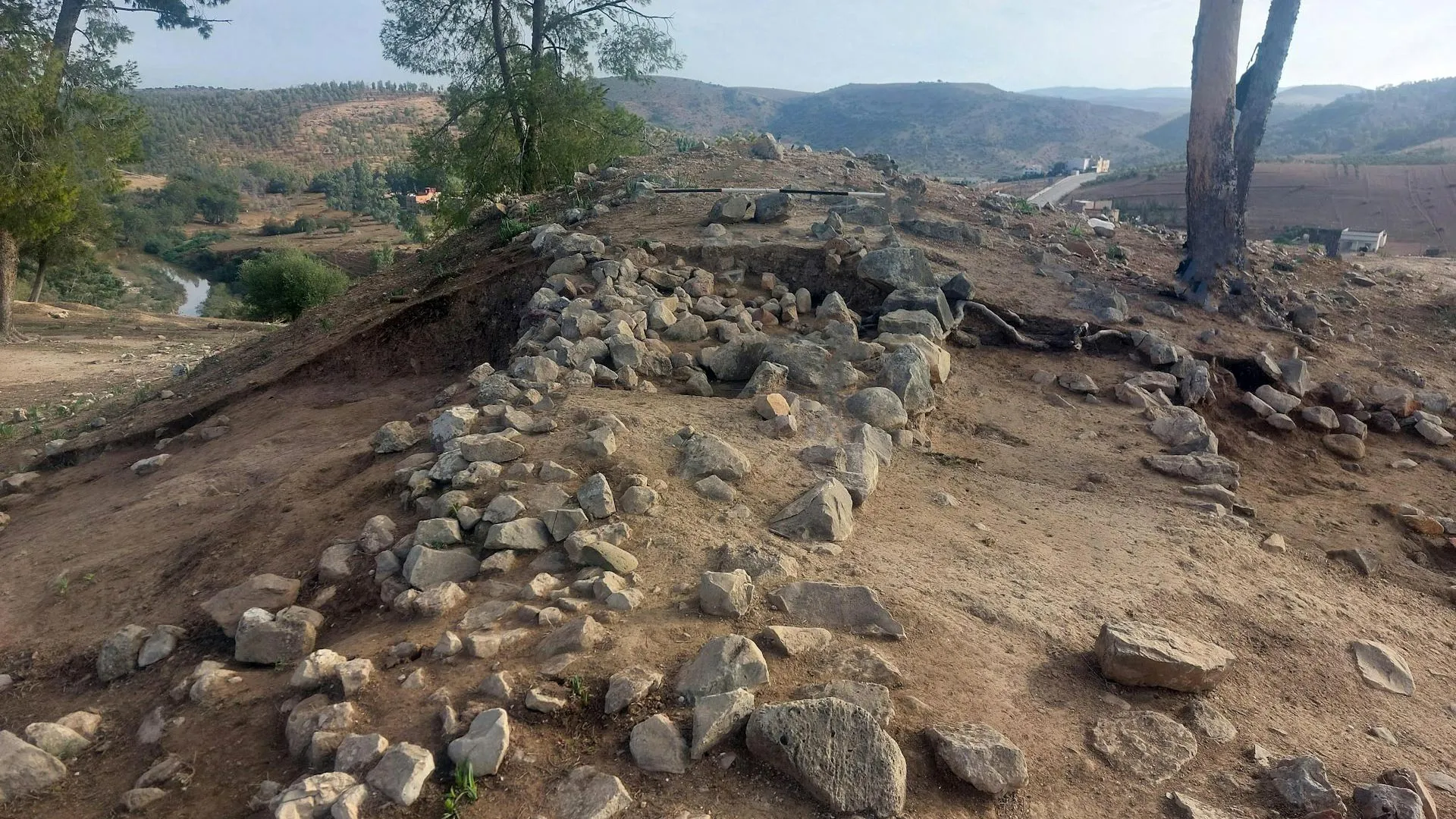
"The helmet is a symbol of power and direct evidence of long-distance contacts." Łysa Góra was a fortified Iron Age settlement located on a sand dune between the Orzyc River and a lake. According to the study, it was inhabited between the 6th and 4th centuries B.C., possibly by people belonging to the West Baltic Barrow Culture. Archaeologists had known about Łysa Góra for decades, with excavations conducted on and off between 1971 and 1992.
However, because few of the finds from those excavations were ever published, Łysa Góra's untapped potential was never fully realized, the study reports. On top of that, its reputation made excavators doubtful of finding anything useful. "We did not know what to expect, as the site had a reputation for being severely disturbed," Kaczyński said.
Then excavations of a ritual pit filled with charred remains revealed something unexpected. Along with adzes and a scythe, they uncovered what appeared to be an unusual bronze vessel. "During the excavation, we uncovered an object made of bronze sheet metal, which we initially thought was a vessel," Kaczyński said.
"It was only when we exposed the tip that we realized we had found a helmet of a very rare type." Similar bronze helmets are known from sites such as Dürrnberg in Austria, located far to the south. Together with around 31 mostly fragmented La Tène brooches and ring ornaments, this suggests Łysa Góra may not have simply traded with the Celts, but may have had Celtic people living there. The helmet could have been traded in, but the study suggests this is unlikely.
Extract — continue reading at the source.