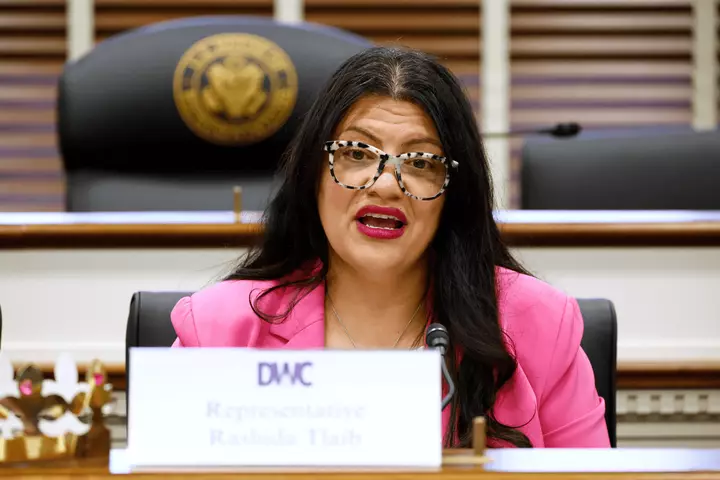
Representative Rashida Tlaib, a Michigan Democrat, has introduced the Get the Flock Out of Our Communities Act, a bill that would prohibit federal money from supporting automated mass surveillance systems, including automatic license plate readers, biometric surveillance and facial recognition technology. The proposal goes beyond blocking new purchases. Systems bought with federal funds would have to be removed within 30 days of enactment, while certain prohibited surveillance data would have to be permanently deleted within seven days.
The congresswoman's legislation arrives amid growing scrutiny of Flock Safety and other automated license plate reader systems over privacy, data sharing and reported misuse, while supporters argue the cameras are valuable crime-fighting tools. Newsweek contacted Tlaib's office and Flock Safety via email for comment on Sunday. Automated license plate readers have expanded into a nationwide law-enforcement tool, bringing a debate over whether their investigative value outweighs the privacy implications of creating searchable records of where vehicles travel.
Congressional scrutiny has accelerated as lawmakers from both parties propose different approaches to limiting or regulating the technology. Tlaib introduced the bill alongside Representatives Sylvia Garcia of Texas, Summer Lee of Pennsylvania, Ilhan Omar of Minnesota, Delia Ramirez of Illinois, Nydia Velázquez of New York and Bonnie Watson Coleman of New Jersey. It has been referred to the House committees on Oversight and Government Reform and the Judiciary.
The legislation defines an "automated mass surveillance system" broadly as automated technology that collects, processes, analyzes, generates, retains, uses or stores information about an indefinite or large number of people. Federal money could no longer be used to purchase, install, maintain, access, lease or operate covered technology. Automatic license plate readers, biometric surveillance and facial recognition systems are expressly included.
Federal agencies and officials would also be prohibited from acquiring, possessing, accessing, soliciting or using covered systems or the information derived from them. During a press conference on Wednesday, the congresswoman said she’s concerned about the suppression of free speech and the possible invasion of privacy. So that gets to be misused by whoever comes in and, it may be changed in the use of it, but the point is it’s not just cameras,” Tlaib said, Michigan Public Radio reported.
"I can’t sign these contracts, right? But I can basically be able to control what law enforcement agencies can use federal funds for, and that’s what we do in this bill.” For equipment already purchased or operated with federal money, the legislation calls for removal within 30 days after enactment. Covered surveillance data barred by the legislation would have to be permanently deleted within seven days, while data obtained in violation of the measure could not be admitted in a court or administrative proceeding.
Extract — continue reading at the source.