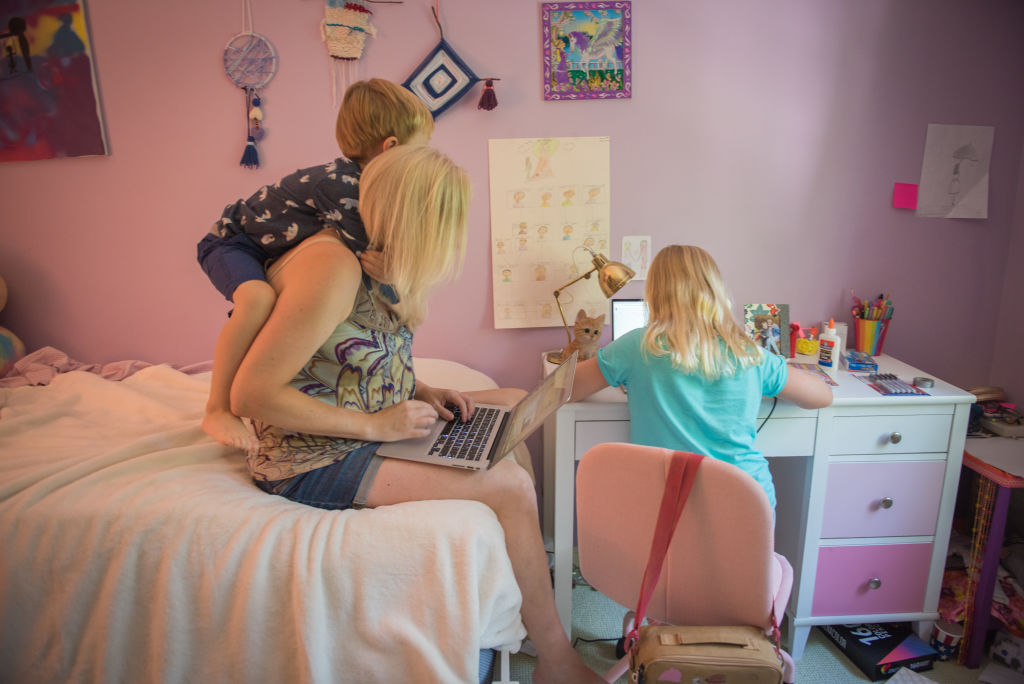
Recently, one of us learned that her five-year-old was forgotten at school. The teenage neighbor who usually walks him home got distracted and forgot to collect him. Luckily, it was easy enough while working from home to dash out, stop at school, and then return to the laptop as he constructed a “dino-chicken-car” with some Legos.
The crisis became a non-issue thanks to remote work. Juggling parenthood and work is tough, and it shows up in our stress levels. The American Psychological Association reports that 48% of parents say that on most days their stress is completely overwhelming—around twice as many as other adults.
Remote work seems to offer a solution. Parents can put dinner in the oven between meetings so that food is ready before kids’ hangry tantrums arrive. A youngster with a virus can sleep through it while Dad takes calls over Zoom, so what would have been a sick day turns into a mostly-productive day.
The time-bind that made it feel impossible to show up for one’s kids and for one’s career can seem less, well, binding. But, weirdly, the rise of remote work hasn’t necessarily improved parents’ mental health, and may have even harmed it. In research published in _Science_, we considered the mental distress of over half a million Americans, measured by taking medication for depression or anxiety, seeing a mental health professional, and other factors.
We compared people in jobs that could be done from home, like software engineers and customer service representatives, to those whose jobs necessitate in-person work, like mechanical engineers and cashiers. If remote work were a panacea for parents, we would expect the mental health of parents in remote-capable jobs to improve a lot with the rise of remote work. But we didn’t see that result.
Instead, parents in remote-capable jobs saw bigger increases in reported depression and antidepressant use than those working in-person jobs. How can remote work, something that so many parents feel eases their days, be potentially harmful to their mental health? Two factors contribute to this phenomenon.
Extract — continue reading at the source.