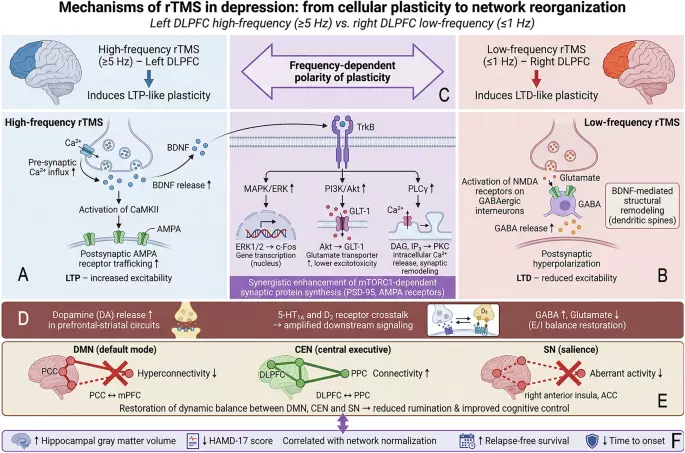
Depression is a highly prevalent and debilitating mental disorder. Pharmacotherapy remains the primary treatment modality; however, its efficacy is often limited by a delayed onset of action, suboptimal response in some patients, and a high risk of recurrence. Treatment-resistant depression, characterized by poor response to conventional therapies, poses a major clinical challenge and highlights the need for improved treatment strategies.
Repetitive transcranial magnetic stimulation (rTMS), a noninvasive neuromodulation technique, has shown promise for depression, particularly when combined with antidepressant pharmacotherapy. Advances in neuroimaging, neurochemistry, and network neuroscience have clarified how high-frequency rTMS may modulate cortical excitability, monoaminergic transmission, synaptic plasticity, and distributed brain networks. Clinical evidence suggests that combined treatment may accelerate early improvement, increase response and remission, and reduce relapse risk; however, these benefits are heterogeneous across patients and symptom domains and should be interpreted in light of expectancy effects and limitations of sham blinding.
Neuroimaging studies have identified treatment-associated functional and structural changes, including hippocampal volume changes, but the causal links among molecular signaling, circuit reorganization, structural findings, and symptom improvement remain unresolved. The interaction between rTMS and antidepressants should therefore not be viewed as uniformly additive or synergistic, but as a state-dependent process shaped by medication class, stimulation protocol and timing, cortical excitability, metaplasticity, and individual neurobiological context. This review integrates mechanistic, neuroimaging, and clinical evidence and discusses how biomarker-, state-, and symptom-informed targeting, optimized treatment sequencing, and pragmatic implementation strategies could improve the precision and accessibility of combined treatment for depression.
This is a preview of subscription content, access via your institution Receive 12 print issues and online access Prices may be subject to local taxes which are calculated during checkout The data summarized in this review were extracted from previously published studies cited in the manuscript. No original datasets were generated or analyzed in this study. Feng MY, Bi YH, Wang HX, Pei JJ.
Influence of chronic diseases on the occurrence of depression: A 13-year follow-up study from the Survey of Health, Ageing and Retirement in Europe. Psychiatry Res. 2023;326:115268. Lundberg J, Cars T, Lampa E, Ekholm Selling K, Leval A, Gannedahl A, et al.
Determinants and outcomes of suicidal behavior among patients with major depressive disorder. JAMA Psychiatry. 2023;80:1218–25. Article PubMed PubMed Central Google Scholar Wang X, Nie X, Zhang F, Wei Y, Zeng W, Zhang Y, et al.
Extract — continue reading at the source.