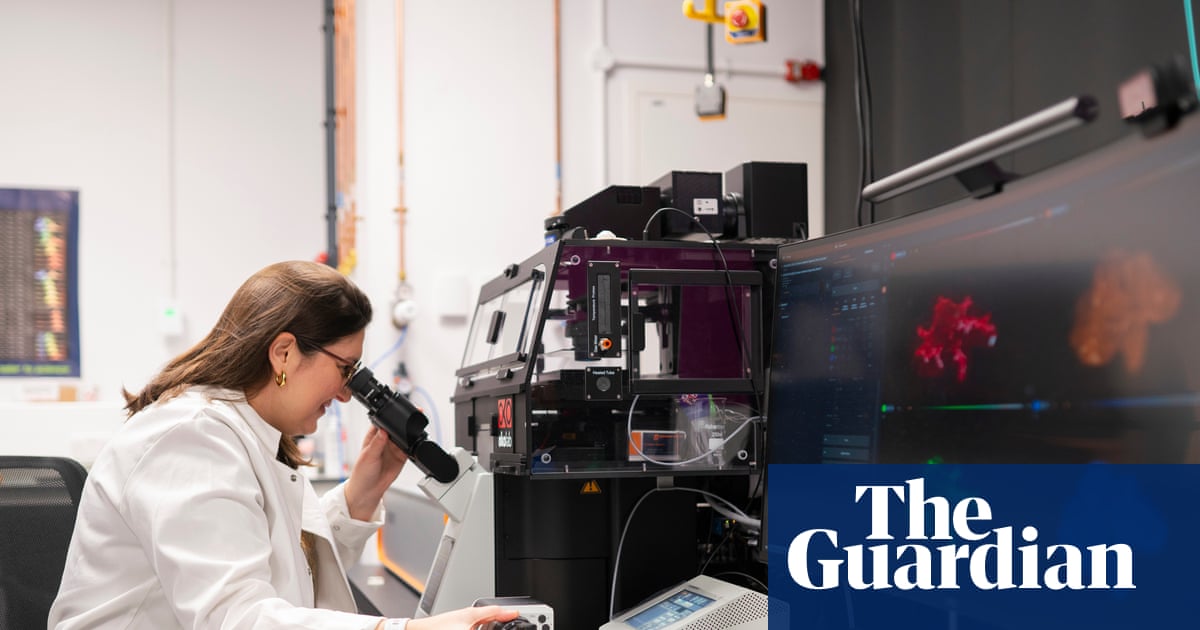
The number of young people living with debilitating and incurable bowel conditions worldwide is growing, but researchers now hope a one-of-a-kind microscope will help them understand such diseases and find new treatments. According to the British Society of Gastroenterology, more than half a million people in the UK are living with inflammatory bowel disease (IBD), with Crohn’s disease and ulcerative colitis the two main forms. While such conditions can develop at any age, experts say they are most often diagnosed between the ages of 15 and 40, blighting lives at a crucial time for education, work and relationships.
Now a new piece of kit could bring fresh hope to those affected by IBD. Yet this is no run-of-the-mill bit of tech: the microscope operates at 10 times the resolution of conventional light microscopy, allowing researchers to see the details down to just 20nm in size. To do so, the microscope, which researchers have nicknamed “Curie”, uses a two-laser technique known as stimulated emission depletion (STED) microscopy that scooped its inventors the Nobel prize in physics in 2014.
In this setup, features of interest within cells are labelled with fluorescent tags – these absorb energy from the first laser beam and then emit light, or fluorescence. A second, doughnut-shaped laser beam overlaps with the area illuminated by the first. Crucially, this second beam “switches off” fluorescence within its outer ring, meaning fluorescence is only detected from the centre of the doughnut – a very small region.
The microscope also has additional features, making it the only one of its kind in the UK. These, Pombo-Garcia notes, include deformable mirrors that can correct for optical distortions caused by the sample. So using this piece of equipment, we are able to visualise these complexes beyond what [we can see with a] conventional microscope,” he said, adding that he was looking at how the structure of these protein complexes changes from foetal development to adulthood.
Ioannidis noted that by understanding what healthy tissue should look like, and then comparing and understanding the differences seen in people with disease, there was the potential to shed light on what had gone wrong. The microscope was unveiled by science minister Chris McDonald, alongside the announcement of £67m of funding for the Rosalind Franklin Institute over the next five years from April 2027, and a further £90m over the same period for the Henry Royce Institute, which focuses on materials research. In both cases, the funding has come from the Engineering and Physical Sciences Research Council via the core budget of UK Research and Innovation (UKRI) set in the 2025 spending review.
The announcement comes at a difficult time for UK science facilities. Earlier this year the Science and Technology Facilities Council (STFC), also part of UKRI, revealed it needs to make £162m in savings by 2030 as a result of factors such as soaring energy costs at its national facilities, increasing staffing costs, an expanded portfolio of activities and “unfavourable movements” in foreign exchange rates. The situation has put some national facilities at risk of closure, with the Diamond Light Source, Central Laser Facility and ISIS Neutron and Muon Source – all of which sit on the same campus as the Rosalind Franklin Institute – jointly facing a 15% drop in funding, leading to concerns from the scientific community.
Extract — continue reading at the source.


