Most Popular PlacesRandom PlaceListsItinerariesAdd a PlaceDownload the App Riga Ghetto and Latvian Holocaust Museum House of Egyptian Architecture Smygehuk Fyr Commercial Signage on the Façade of Gruta 77 Where to See the World’s Most Famous Preserved Body Parts 3 days ago Atlas Obscura’s Guide to America’s Most Haunted Cemeteries 10 days ago The Best Haunted Hotels to Book for a Spooky Getaway 19 days ago A somber place of memory and reflection, that tells the story of Riga's Jewish community before and during World War II. Riga Ghetto WWII Bundesarchiv, Bild 183-N1212-325 / Donath, Otto Riga WWII Bundesarchiv, Bild 183-N1212-325 / Donath, Herbert Riga Ghetto WWII Bundesarchiv, Bild 183-N1212-325 / Donath, Otto Riga WWII Bundesarchiv, Bild 183-N1212-325 / Donath, Herbert Riga Ghetto WWII Bundesarchiv, Bild 183-N1212-325 / Donath, Otto Riga WWII Bundesarchiv, Bild 183-N1212-325 / Donath, Herbert Riga Ghetto WWII Bundesarchiv, Bild 183-N1212-325 / Donath, Otto Riga WWII Bundesarchiv, Bild 183-N1212-325 / Donath, Herbert Established and opened in 2010 by the Shamir religious community with assistance from the Riga City Council, the Riga Ghetto and Latvian Holocaust Museum is located in the district of Spīķeri, close to its border with Latgale district,the site of the former Jewish ghetto. Immediately noticeable upon approaching the site is the reconstruction of the ghetto's barbed wire fencing and cobbled stone streets.
Next to this is a memorial wall, inscribed with the names of close to 70,000 Jewish casualties, both native and foreign, who perished in Latvia during World War II. The railway carriage in the middle of the courtyard is labeled with the many locations across Europe from where victims were transported to Riga. Further along the courtyard, the memorial wall showcases eerie photos of murdered Latvian Jews and the Riga Ghetto.
Another exhibition wall features graphic images of the concentration camps and the mass executions committed by the Einsatzgruppen, the SS death squads. Also in the courtyard is a restored traditional green painted Latvian wooden house. Originally located in the ghetto, it was restored and relocated to the grounds of the museum.
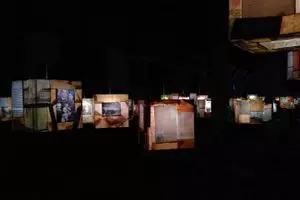
The interior shows the cramped and harsh living conditions that its residents were subjected to during the war. The courtyard itself is sandwiched between two old factory buildings, one of which houses the stark "3000 fates" exhibit.Illuminated wooden cubes suspended from the ceiling display photos and documentation of some of the roughly 3000 Czech Jews forcibly transported to Riga from the Terezin Ghetto, of whom only 128 survived. The museum has little in the way of interactive displays, with emphasis placed on the solemn grounds and deeply moving exhibits, providing visitors with a full insight into the horrors that Riga experienced during World War II.
Get more unusual and extraordinary places each week with the Atlas Obscura Places newsletter. Your newsletter subscriptions with us are subject to Atlas Obscura's Privacy Policy and Terms of Use. The museum is open from 10AM - 6PM on Sunday to Friday, closed on Saturdays.
Standard admission fee is €5 for adults and €3 for children, students, and seniors. A series of markers along one side of an Amsterdam canal memorialize the Jewish residents from the other side who died in the Holocaust. A suburban monument preserves the faces of twenty murdered Jewish boys and girls.
Extract — continue reading at the source.