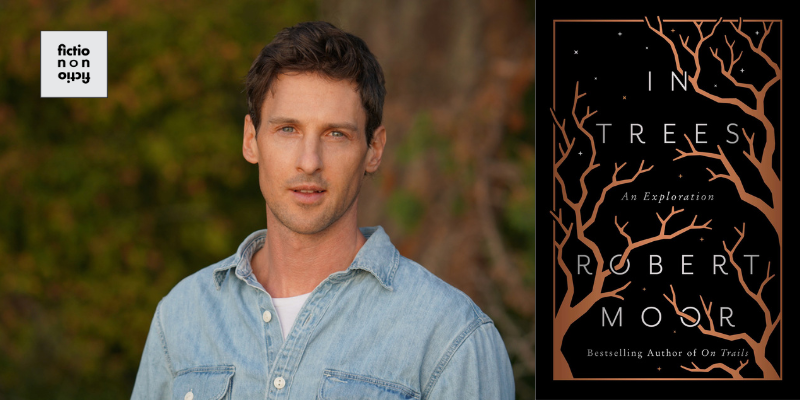
Nonfiction writer Robert Moor joins co-hosts Christian Barter and Jennifer Maritza McCauley to talk about his new book, In Trees, and the power of “tree thinking,” a concept developed by the evolutionary biologist Robert J. Moor explains how this form of thought emphasizes branching, growth, and pruning, as opposed to hierarchical ordering, and shows how these principles can be identified in the work of writers like Tolstoy and Wordsworth. He explores the role the giant sequoia played in founding modern conservatism and takes listeners on a tour of his own experiences in the trees from Papua New Guinea to Vancouver, Canada, where he participated in a tree sit with activists protesting an oil pipeline.
He discusses the ethics of climate activism and how tree thinking might help us re-imagine the environmental movement for a new age. To hear the full episode, subscribe through iTunes, Google Play, Stitcher, Spotify, or your favorite podcast app (include the forward slashes when searching). You can also listen by streaming from the player below.
Check out video versions of our interviews on the Fiction/Non/Fiction Instagram account, the Fiction/Non/Fiction YouTube Channel, and our show website: https://www.fnfpodcast.net/ This podcast is produced by Whitney Terrell. In Trees by Robert Moor | Moon Palace Books • On Trails by Robert Moor | Moon Palace Books The Baron in the Trees by Italo Calvino • “The Trouble with Wilderness” by William Cronon • On the Origin of Species by Charles Darwin • Nature by Ralph Waldo Emerson • How to Blow Up a Pipeline by Andreas Malm • Walden by Henry David Thoreau • Fiction/Non/Fiction Season 9, Episode 56: Matthew Wolfe on the Secret History of Radical Environmentalism EXCERPT FROM A CONVERSATION WITH ROBERT MOOR Christian Barter: You have the book divided into tree-related concepts. The chapters are named after branching, pruning, gnarling, rooting, and so on.
Your chapter on branching is an especially literary one, and I found it especially thought-provoking. You make a comparison between two writers to demonstrate the difference between narrowing and branching, Wordsworth and Tolstoy. Would you tell us about this comparison and why you chose these two particular writers to make it?
To back up a little bit, the chapter begins when I go to try to climb a tree near my house here where I live, and it is something I’d done as a kid, as you say. I imagine most people do, and then interestingly enough, most people stop for some reason. This tends to be a trend across cultures, and I was sitting there reading actually a book called The Baron in the Trees by Italo Calvino, which you guys have probably read, and thinking about why did I stop climbing trees?
You know, it’s a story of a boy who climbs up into a tree and never comes back down, spends his whole life up there. So I went to climb this tree, and almost right away was seized by this feeling of vertigo, this feeling of cautiousness. You know, it wasn’t just a fear of heights.
Extract — continue reading at the source.