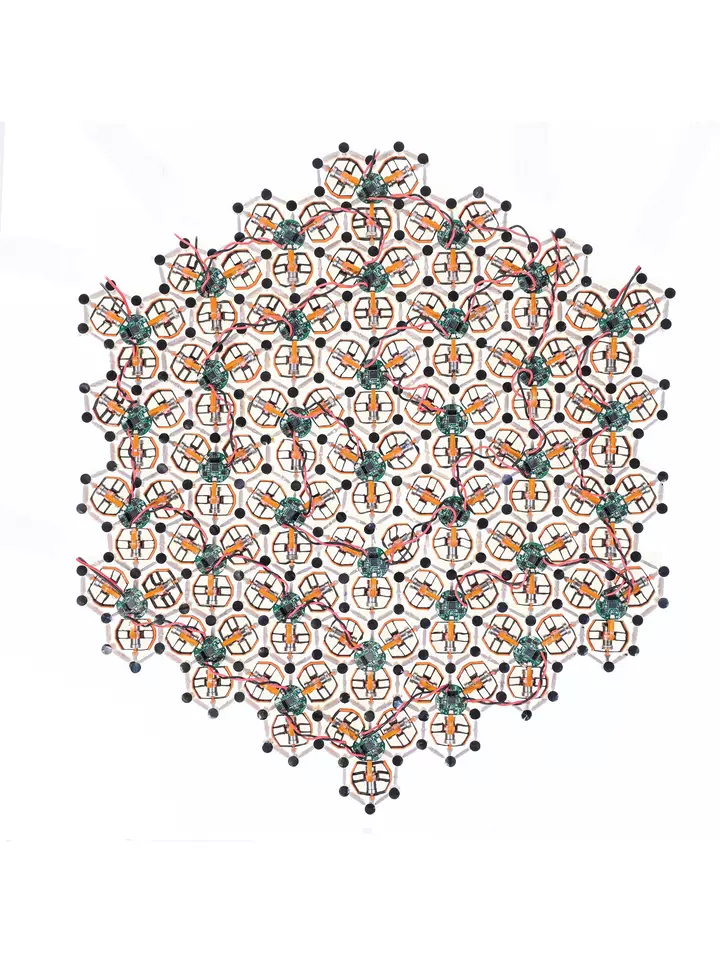
This article has been reviewed according to Science X's editorial process and policies. Editors have highlighted the following attributes while ensuring the content's credibility: Scientists have developed a material that can grow and coordinate its own movement until the entire structure pulses in unison, paving the way for versatile robots that behave more like living systems. Publishing their findings today (Oct. 14) in Nature, engineers from the University of Birmingham working with the universities of Amsterdam, Lyon, Delft, Leiden and Cambridge reveal that they have created a mechatronic metamaterial that behaves as a 'time crystal.' Time crystals are an unusual form of matter in which particles endlessly move in regular, repeating cycles.
But here, the "particles" were not the atoms of molecules: they were robots. The scientists' experimental material combines elastic structures, sensors, electronics and actuators so that neighboring components can influence one another. The key ingredient to generate the time-crystalline state was making the interactions between components "nonreciprocal," meaning that one component's response to another does not have to be mirrored in reverse.
When reciprocity was broken in the material, individual vibrations initially appeared at short wavelengths, but then progressively grew in wavelength, period and amplitude—resulting in a globally synchronized state that the researchers demonstrate is a time crystal. The team describes the process they have discovered as 'wave coarsening." Co-lead author Dr. Jack Binysh, from the University of Birmingham, started working on the project at the University of Amsterdam.
He said, "Our research is a beautiful example of what robotics can teach us about physics, and vice versa. It's also a showcase for combining fundamental physical concepts about different states of matter with outstanding technical expertise in mechatronic fabrication." "Our research provides a striking example of spontaneous organization—tiny vibrations organizing themselves until an entire material moves in a coordinated way. Like musicians gradually finding the same beat, individual parts of an active material can organize their movements until the whole structure moves together." "Wave coarsening could be exploited as a way of controlling shape changes and directed motion—proving useful in robotics, active matter and optomechanics.
Our discovery could form a key step toward the development of biology-inspired multifunctional robots." The researchers first constructed a 2D honeycomb material made from 37 active units. When pushed beyond a stability threshold, individual units began self-oscillating at around 30 Hz. Gradually, longer waves came to dominate until the entire material oscillated collectively.
They then constructed an elastic ring containing 24 motorized units. Initially, higher-frequency deformation patterns appeared around the ring. These progressively combined into larger patterns until the ring settled into a slow collective cycle.
Extract — continue reading at the source.