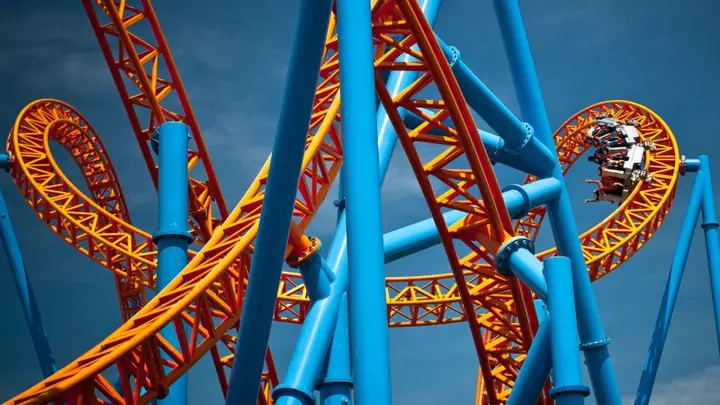
The first roller coaster in the United States to loop upside down tucked riders by twos into bench seats, secured them with a single seat belt and subjected them to an estimated 7.5 times the force of gravity (some say it was closer to 12 g). The Flip Flap Railway opened in New York City’s Sea Lion Park in 1895, where the roller coaster reportedly strained backs, wrenched necks and dazzled spectators until the park closed in 1902. Now, roller coaster safety is in the news again.
In September, three lawsuits were filed against Six Flags and ride manufacturer S&S Global, alleging that riders sustained “catastrophic” brain injuries on the roller coaster X2 at California’s Magic Mountain theme park. These are just the most recent cases related to the ride, filed after a CNN investigation found dozens of injuries on X2 leading to hospitalization, disability and death. On September 29, Six Flags announced X2 would shut down permanently even though it said the ride “consistently passed a multitude of safety tests.” Weeks later, the company said it would temporarily close another nine coasters across the United States and Canada after a man fell from his seat on the roller coaster Goliath and died at Six Flags Over Georgia.
Six Flags announced Oct. 24 that it would add seat belts to Goliath and other coasters, and a spokesperson told Science News that the company is “committed to rigorous ride inspection, maintenance and safety procedures.” But the incidents and closures are prompting new questions about coaster design and safety — particularly when they are operating correctly — and whether guidelines overlook crucial factors. Roller coasters are not regulated at the federal level in the United States; each state has its own approach to their management. But an international technical group comprising over 1,000 industry professionals, the ASTM Committee F24 on Amusement Rides and Devices, publishes recommendations that are considered industry standards.
The first ASTM standards for roller coaster design were released in 1982. Consumer Product Safety Commission had been stripped of authority to regulate fixed-site amusement rides the year before. In the wake of this newfound freedom, it was a “roller coaster arms race,” says Brian Avery, an event and tourism management researcher at the University of Florida in Gainesville who studies risk and amusement ride safety protocols.
The period was characterized by attempts to “build it taller, faster, longer.” When X2, originally called X, opened in 2002, it was the world’s first fourth-dimension coaster. It catapulted people 60 meters high, traveling 122 kilometers per hour while its seats rotated independently on their own tracks. In the 24 years since, only 20 or so other fourth-dimension coasters have been built, and several have closed.
As roller coasters grew more extreme, injuries increased and were more publicized, sparking calls for further research and regulation. Generally, roller coasters are quite safe. Out of 1.7 billion annual amusement park rides across North America, just 652 roller coaster injuries were reported in 2024 by parks choosing to share data.
Extract — continue reading at the source.