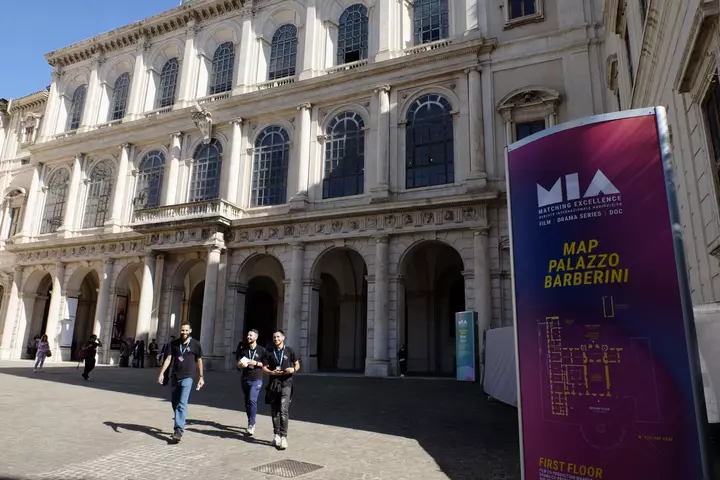
The 12th edition of Rome’s MIA Market came to a close on Friday with market head Gaia Tridente heralding “a stronger, renewed edition of MIA, with a more ambitious and expanded program,” that saw a high-powered cohort of European and global industry guests — including Banijay Entertainment CEO Marco Bassetti, Studiocanal CEO Anna Marsh, Bad Wolf CEO Jane Tranter, and filmmakers Edward Berger (“All Quiet on the Western Front”) and Asif Kapadia (“Amy”) — arriving for a lively week in the Eternal City. This year’s market expanded its footprint beyond its traditional home in the Palazzo Barberini and adjacent Cinema Barberini, incorporating several new venues along the elegant Via Veneto — of “La Dolce Vita” fame — and in the process “making the city itself an integral part of the market’s identity and experience,” according to Tridente. She went on to say that those changes represented “probably been one of the biggest transformations of MIA, and certainly one of the most challenging from an organizational perspective.” “We have completely reimagined the geography of the market, creating a new industry district in the heart of Rome, with Palazzo Barberini as our main hub and a network of venues along Via Veneto,” she said.
We wanted to create a different experience for our participants, with dedicated spaces for the different activities, while keeping everything within walking distance. I believe this new structure gives MIA a much stronger identity and offers us room to grow,” she continued. The city is not just a backdrop for MIA; it is part of what makes the market unique.” This year’s event witnessed several other significant changes, including the introduction of a new gap-financing market for animation series and the launch of a dedicated strand showcasing the range of financial tools available to European producers and the growing role of equity capital in film and television production (more on that below).
The market also shifted its dates to take place alongside the Rome Film Festival, as well as Alice nella Città, an autonomous festival that runs parallel to the Rome fest. Here are Variety’s takeaways from a busy week in Rome: Unprecedented turbulence, untapped potential The 12th edition of MIA marked the first industry confab to take place since the Red Wedding-style bloodbath at Netflix, which saw the Los Gatos-based streamer ax 1,000 employees — around 6% of its workforce — including chief content officer Bela Bajaria and head of film Dan Lin, whose firing was announced on Monday just hours before MIA attendees gathered for an opening reception in Rome’s lavish Palazzo Barberini. The firings were the latest in a series of shake-ups, retrenchments and mergers — including Paramount Skydance’s acquisition of Warner Bros.
Discovery to form Skydance Corp. — that are recasting the shape of the industry, with many still puzzling over what such seismic shifts will mean for the landscape of production and distribution moving forward. For some execs in Rome, such turbulence invites a chance to think outside the box — and seize the moment. Contraction represents opportunity,” said Roeg Sutherland, who is co-head of CAA’s media finance department and its international film group.
People that are going to challenge the status quo. Because the business is moving so fast.” For European producers, there’s also an upside when pan-European studios like Banijay, Mediawan and Vuelta go on a buying spree. And usually, the creative stays with the producer.” In a keynote speech in Rome, Marco Bassetti, CEO of London-based Banijay Entertainment, the world’s largest independent studio, said that “the major debate currently taking place in Europe … is about recognizing and providing compensation for creativity.” That debate is taking different forms, from the ramped-up efforts of European producers to retain IP rights to the ongoing calls for quotas that would require global streamers to invest a portion of their revenues into local productions.
Extract — continue reading at the source.