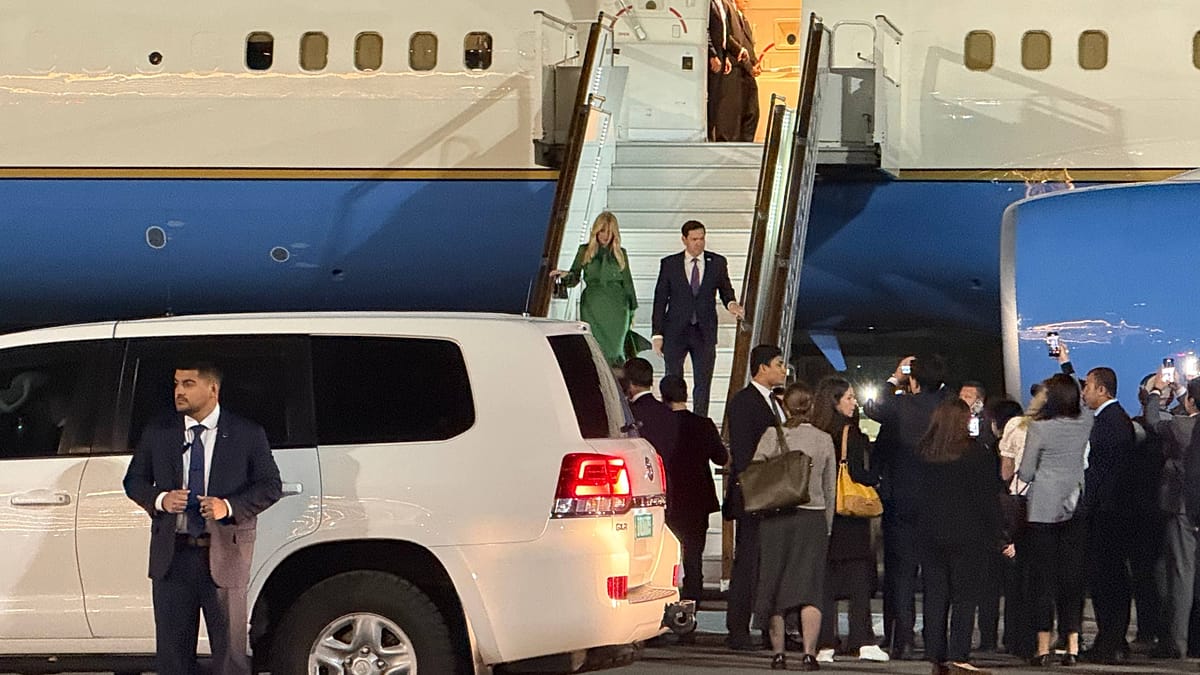
US Secretary of State Marco Rubio arrived in Samarkand, Uzbekistan, on Sunday evening ahead of talks with representatives of five Central Asian countries, as Washington seeks to expand diplomatic, economic and security cooperation with the region. Rubio will attend a ministerial meeting under the C5+1 format, bringing together the United States and Uzbekistan, Kazakhstan, Kyrgyzstan, Tajikistan and Turkmenistan. He is also scheduled to hold bilateral talks with senior officials from all five countries.
The visit has a significant commercial dimension. According to the US State Department, Rubio is accompanied by a delegation of more than 200 American business leaders, with discussions expected to focus on opportunities for trade, investment and economic cooperation. Speaking to reporters at Joint Base Andrews on Saturday, before leaving Washington, Rubio was asked why he had chosen to visit Uzbekistan while several international crises demand American diplomatic attention.
"This is an important relationship," Rubio said, explaining that the timing had been chosen to bring together the foreign ministers of all five Central Asian countries. "One of the things that suffers is the strategic business," he said, referring to the tendency for diplomatic visits to focus on immediate crises. "But there's countries you'd like to get to because we want to build our relationships with them." The C5+1 framework was established in Samarkand in November 2015, when then-US Secretary of State John Kerry met his counterparts from the five Central Asian republics.
The dialogue subsequently expanded to presidential level, with meetings hosted by Joe Biden in 2023 and Donald Trump in November 2025. The most recent summit in Washington placed particular emphasis on trade, investment and critical minerals. According to the US Department of Commerce, more than $25bn (approximately €22bn) in commercial agreements and commitments were announced during the November 2025 C5+1 meetings, covering aviation, agricultural equipment, railway infrastructure and mineral development.
These included agreements at different stages of development rather than investments already completed. Kazakhstan and Uzbekistan are among Washington's main economic partners in the region. According to US government figures, bilateral trade in goods and services reached $7.1bn (approxiametely €6.3bn) with Kazakhstan and $1.7bn (€1.5bn) with Uzbekistan in 2025, while American companies have also announced agreements covering aircraft, agricultural machinery and mineral development.
Central Asia offers Washington opportunities to diversify critical mineral supply chains and develop partnerships in energy, transport infrastructure and technology. The region has substantial oil, natural gas and uranium resources, alongside deposits of other minerals used in manufacturing, advanced technologies and energy systems. For Central Asian governments, closer ties with the United States offer additional sources of investment, technology and access to international markets, while they maintain extensive economic relationships with Russia and China.
Extract — continue reading at the source.