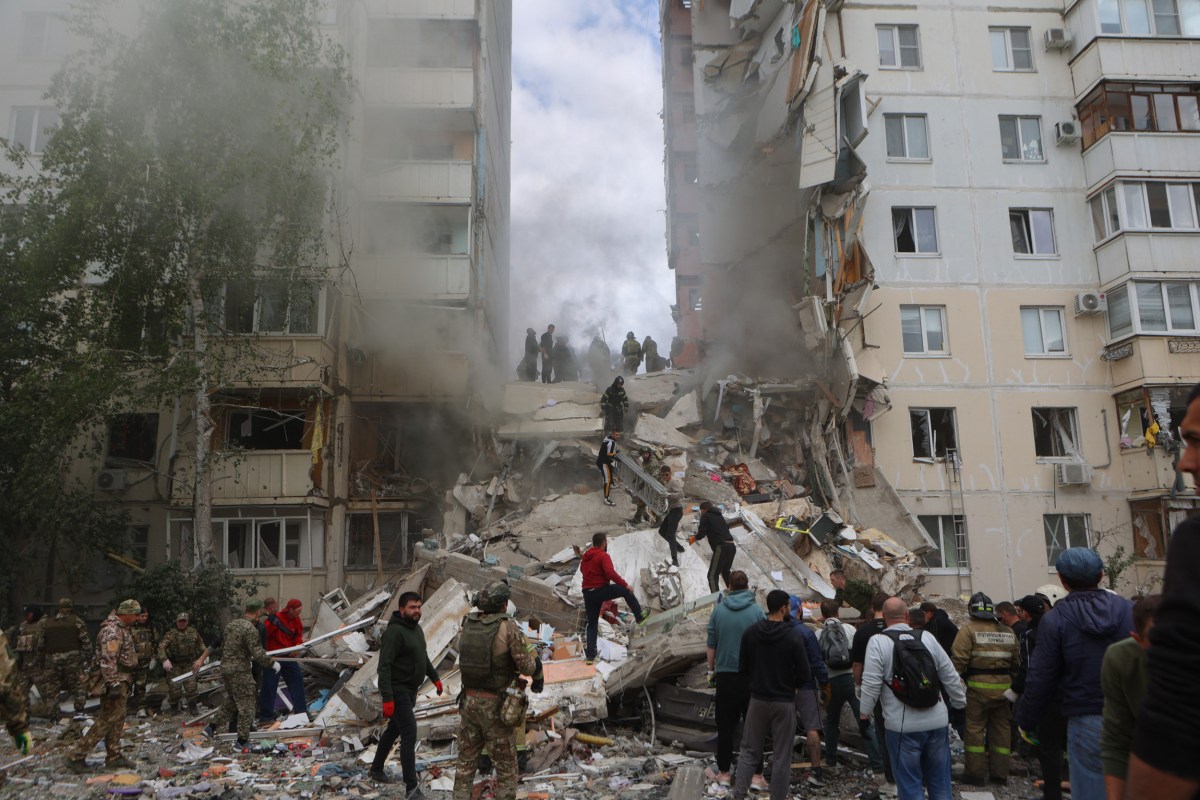
Russia is so vast that some citizens living in remote parts of the Far East may not even know their country is at war. Residents of Belgorod certainly can't enjoy such blissful ignorance. The Russian region, which sits immediately north of Ukraine’s Kharkiv and contains key supply routes for Vladimir Putin’s forces engaged across the border, now faces incessant Ukrainian drone attacks.
To protect civilians from the strikes, Belgorod’s Digital Development Ministry did a commendable thing: it launched an app to warn residents of oncoming UAVs and show threatened areas on a map. Then, the state blocked it from working properly. It’s the latest perverse example of how Russian civilians are paying the cost for Putin’s special military operation.
Russian officials are scrambling to protect civilians from a problem created by the invasion of Ukraine, only to discover that one supposed countermeasure has cancelled out another. The app, called “BPLA Belgorod Region”—BPLA is the Russian acronym for UAV—appeared on Russia’s RuStore marketplace on September 1. Upon installation, the app stores a map of Belgorod onto the user’s smartphone, then warns users of possible drone strikes via push and audible alerts, highlighting areas under threat.
On September 6 alone, the region’s operational headquarters said 269 Ukrainian drones attacked 17 municipalities. Three civilians were killed and seven more were injured. Unfortunately, smartphone apps have one fairly traditional requirement to function properly: an internet connection.
In Putin’s Russia, that can be hard to come by, because authorities have imposed widespread restrictions on mobile internet since May last year. The official justification is security; Russian authorities restrict mobile internet during drone threats ostensibly because cellular networks and SIM cards can potentially assist drones with navigation and communications. There is, however, another convenient feature—it gives the state extraordinary influence over what the Russian public can see and share online.
When viewed in tandem with Russia’s crackdown on private and foreign social media and messaging apps, and attacks on VPN providers, the mobile internet blackouts represent another lever the Kremlin can pull to centralize control of the information space. To prevent Russians from being completely cut off, authorities maintain “whitelists”—a small set of approved websites and domains that remain accessible to the public during a shutdown. But, judging by several user reviews on RuStore, Belgorod’s drone warning app has not yet made the cut.
Extract — continue reading at the source.