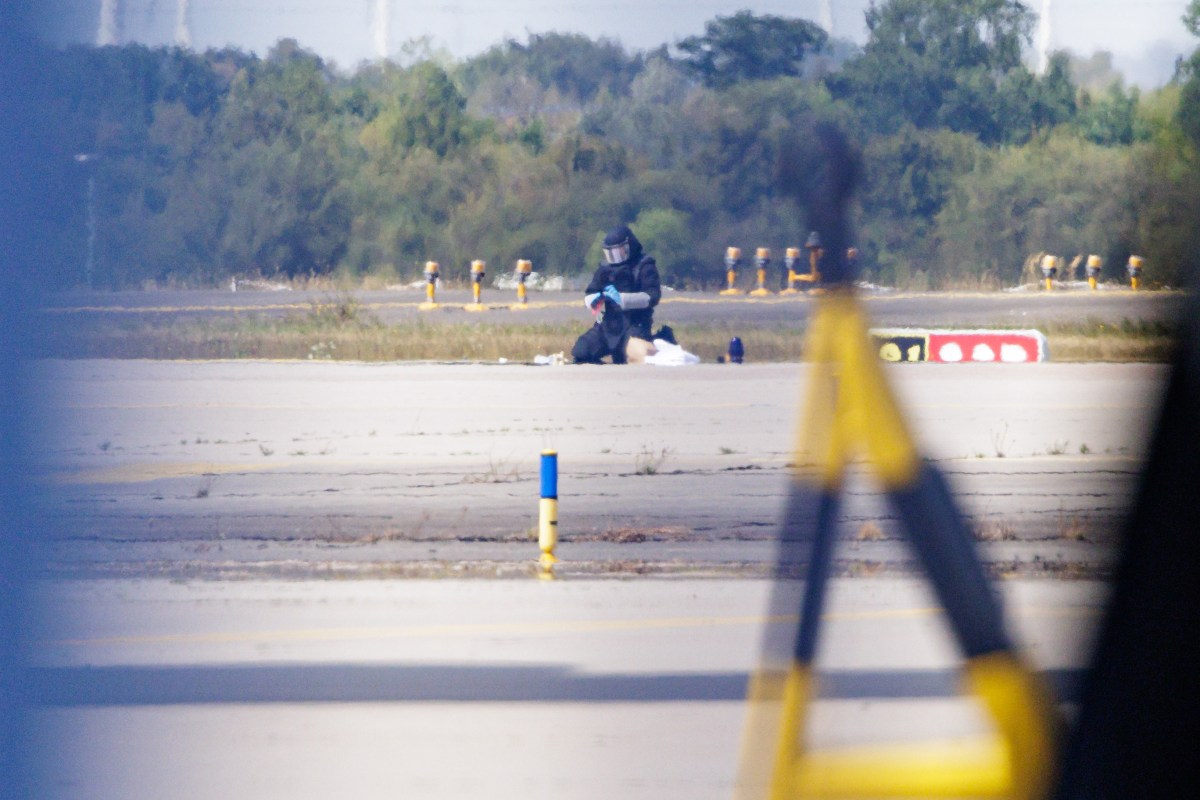
With Europe already in the grips of its deadliest conflict since World War II, a shadowy campaign being waged beyond the battlefield in Ukraine threatens to spark a dangerous escalation between NATO and Russia. And Germany's announcement Tuesday saying Russia was responsible for an incident reportedly involving an explosive-laden drone last month at Leipzig airport marks the latest sign that U.S. allies are woefully unprepared. "The Leipzig attribution fits a pattern of intensifying Russian sub-threshold activity across Europe, and the trend line clearly points toward escalation rather than restraint," Franz-Stefan Gady, adjunct senior fellow at the Center for a New American Security's defense program, told Newsweek.
He argued that such activities are particularly "attractive" to Moscow, which has denied responsibility for the incidents, because, unlike conventional military operations, "they degrade allied cohesion without triggering Article 5," NATO's mutual defense clause. "There is no such thing as an accidental war or inadvertent escalation," Gady said. "Escalation is always a political choice, and the real risk is that Russia eventually judges NATO too divided and too slow to respond given the relatively soft German response to Leipzig, which is exactly where allied preparedness falls short.
"There are still no agreed thresholds for a collective response, and the capabilities that would matter in a crisis, from SEAD [suppression of enemy air defense] to long-range strike and interceptor stocks, are severely depleted because of the Ukraine and Iran wars or need building up." The August 4 incident at Leipzig reportedly involved the use of a first-person view quadcopter carrying a Semtex-style plastic explosive load near a Ukrainian Antonov An-124 loaded with ammunition supplied from France. A day after the drone was found near the aircraft without detonating, a Boeing cargo flight reported colliding with an unidentified object believed to be a second drone that has yet to be recovered by German authorities. The German Interior Ministry on Tuesday called the incident part of a "well-established pattern of Russian hybrid operations in Europe." Germany summoned Russian Ambassador Sergey Nechaev, terminated the lease of the Russian House of Science and Culture in Berlin and Russia's consulate in Bonn, and introduced new visa restrictions on Russian citizens.
Russian officials have repeatedly dismissed any involvement, with Nechaev most recently telling journalists on Wednesday that German authorities had yet to provide concrete evidence linking the incident to Moscow. "We are being accused of no less than committing a terrorist act or attempting to do so," Nechaev said, according to the Russian state-run TASS News Agency. "Some testimony, material evidence and professional assessments—in short, a solid case—should support such serious accusations.
Therefore, all this is perplexing to say the very least." It's far from the first time Russian officials have denied ties to drone incidents in Europe. Since at least September of last year, the same month that reported Russian drones crossed into Polish airspace, a number of small drones have been sighted near airports and infrastructure in several NATO countries, with officials often laying blame on Moscow. Meanwhile, NATO has stepped up military exercises near Russia's borders, including in the Arctic, where Russian Foreign Minister Sergey Lavrov accused the alliance Monday of "driving the region toward militarization and creating hotbeds of international tension." As frictions intensify, Dmitry Trenin, academic supervisor at the National Research University Higher School of Economics' Institute for Global Military Economics and Strategy in Moscow, told Newsweek that he felt "the threat is growing" of a direct clash between Russia and NATO.
"My feeling is that various European governments have come to the conclusion—indeed, illusion—that Russia will not dare touch them in any retaliatory strike," Trenin said. "In my estimate, they have come too far already and are courting extreme danger." And should such a confrontation erupt, he warned that deteriorating security conditions could escalate the conflict into a nuclear crisis. "Nuclear deterrence, alas, has dangerously weakened through irresponsible behavior of NATO nations that de facto have become participants in the war in Ukraine," Trenin said.
Extract — continue reading at the source.