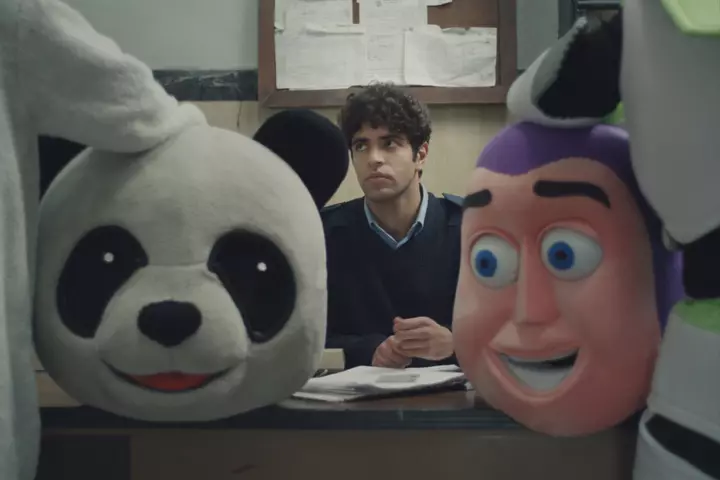
An ill Muslim woman on the margins of society is thrown together with a Coptic security guard traumatized by a terrorist incident in this beautifully realized drama of two outcasts trying to survive. In the hands of a director who loves his characters, the term “spare” to describe the style of a film should in no way imply a lack of warmth. On the contrary, minimalism can contain the essence of a story which might otherwise be constricted when set in a more distracting, less generously proportioned framework.
Such is the case with Mohammed Hammad’s virtuosic control of style and subject in “Safe Exit,” his long-awaited sophomore feature that premiered in the Berlinale’s Panorama program earlier this year. Rigorous in form without sacrificing its emotional power, the film addresses outsider status and the fear of terrorism in contemporary Cairo, proving that Hammad’s confident grasp, evident in his 2016 debut “Withered Green,” is the real deal. On the outside, the challenges were great.
The Christian male protagonist Samaan (Marwan Waleed) is a socially awkward young man traumatized by a terrorist incident that led to his father’s murder. Hampered by his inability to express himself, he records his thoughts in a journal heard in voice-over; the device could easily have been exposition-heavy, yet Hammad’s ultra-tight script avoids any feeling of didacticism. Instead, it concisely reveals Samaan’s ordeal when younger of being kidnapped by ISIS terrorists in Libya together with other Coptic families, and the survival guilt he lives with when he was let go.
Samaan works the night shift as a security guard in an apartment building that, like so many similar buildings in Cairo, is a microcosm of class and economic disparity — in which a coldly unpleasant lobby gives no sense of either the well-maintained apartments nor the rabbit-warren of illegal constructions on the roof where the young man lives. Needing to pay a lawyer to help his brother in detention following an altercation, Samaan makes a deal with a resident (Magda Mounir) hiding her terrorist son Abdullah (Hazem Essam) in her home, by which Samaan signals the arrival of police so the guy can hide in a rooftop water-tank when the building is being searched. An on-site doctor’s office draws Fatimah (Noha Foad), an undocumented, illiterate Muslim woman suffering from seizures.
Discovering that charity cases are only seen the following day, she gives herself to daytime security guard Amm Araby (Samer Al Miniawy), hoping for a place to sleep the night, but the guy chases her away afterwards and Samaan reluctantly allows her to stay over. Whereas Samaan is almost pathologically unassertive, Fatimah knows how to work her smile as well as her body, covering stark vulnerability with a flinty sense of self-protection. Director-writer Hammad subtly adds layers to each character, refusing to allow either one to be reduced to mere victimhood.
Samaan has written a novel — revealingly titled “Who Am I?” — which he hopes to get published, only to discover that the publisher charges production costs to the author. Fatimah’s seizures are diagnosed as symptoms of an operable brain tumor, but with no papers (despite being Egyptian), she’s ineligible for state-sponsored healthcare. The hesitant, unexpected rapport that develops between these two marginalized people holds out the hope of redemption, only to be dashed in a moment of panic mixed with blind cruelty.
Extract — continue reading at the source.