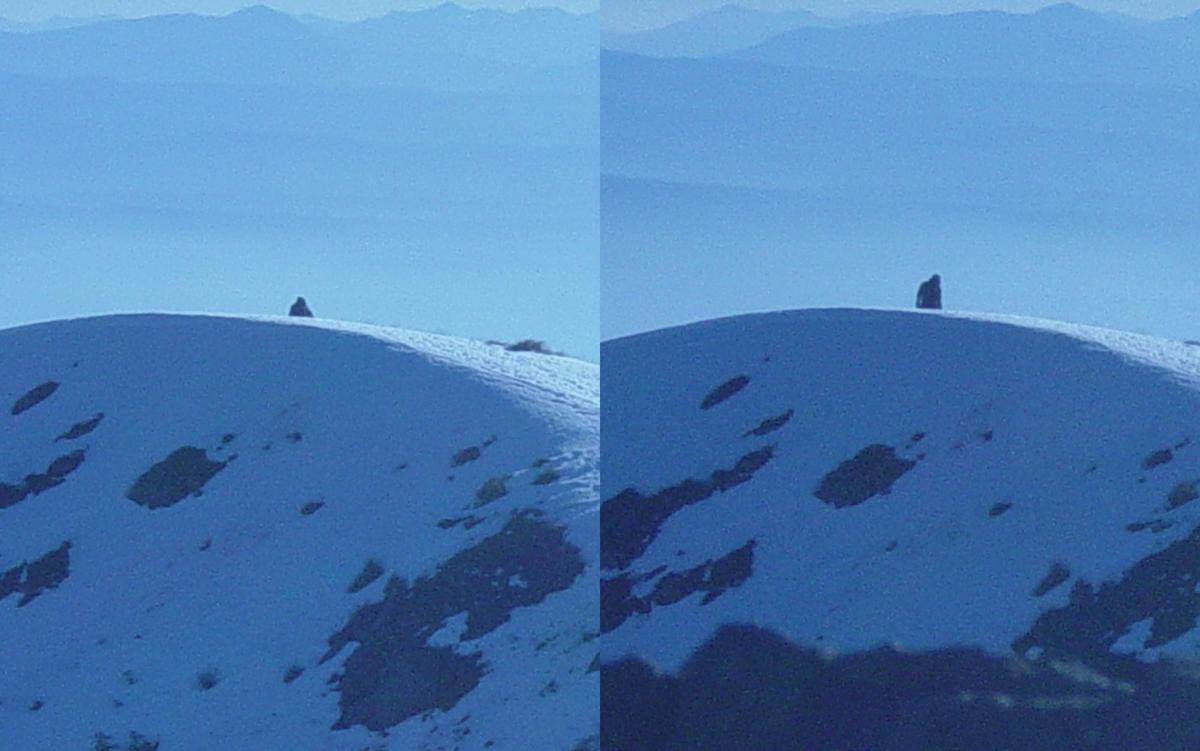
A backpacker from Vancouver, Washington, took these photos on Silver Star Mountain outside Yacolt, Washington, on 17 November 2005. Courtesy the BFRO How do you go about capturing a monster? The search for Bigfoot, or Sasquatch – often referred to as Bigfooting – may sound like a whimsical endeavour: an activity of tall tales and cartoonish representations.
Yet if you spend time listening to what Bigfooters themselves have to say, you discover a different picture. To research our book, Bigfooters and Scientific Inquiry: On the Borderlands of Legitimate Science (2026), we conducted more than 160 interviews, mostly with classical Bigfooters, who spend time in the forests of North America, collecting evidence and, as they see it, acting responsibly, rationally and scientifically. As sociologists of science, we began with a simple premise: whatever one thinks about whether Bigfoot actually exists as a biological creature, Bigfooting undeniably does.
If Bigfooting is a community – or set of communities – that are collecting, analysing, sharing, validating and contesting evidence, then Bigfooting is a suitable object of sociological enquiry. And so, we went on our own hunt to track down Bigfooters and make sense of how they themselves make sense of the world. Before we began our sociological exploration of Bigfooting, we were cautioned that Bigfooters were anti-science.
The truth is much more complex. Yes, Bigfooters work in opposition to mainstream institutional science, making claims about the world that do not accord with the scientific consensus. However, our research revealed that Bigfooters are not dismissive of scientific principles.
In fact, many are dedicated empiricists who employ methodologies modelled on those found in professional scientific research. As George Eberhart, a cryptozoologist and Bigfooter, explained to us: ‘It’s not a part of mainstream science, it really isn’t. But you can apply a scientific method, or a journalistic method to it, to get some good science out of it.’ Yet Bigfooters are not ‘citizen scientists’ in the way we might be familiar with, due to their counter-establishment orientation and alternative vision of what ‘good’ science means.
To a degree, the Bigfooter scientific model echoes that of the natural philosophers of previous centuries, in which individualism was valorised, and where testimony, anecdote and personal experience carried evidential weight. So, how do contemporary Bigfooters use scientific technologies and techniques in their pursuit of evidence – and, ultimately, proof? And what makes their commitment to empiricism different from mainstream science?
Extract — continue reading at the source.