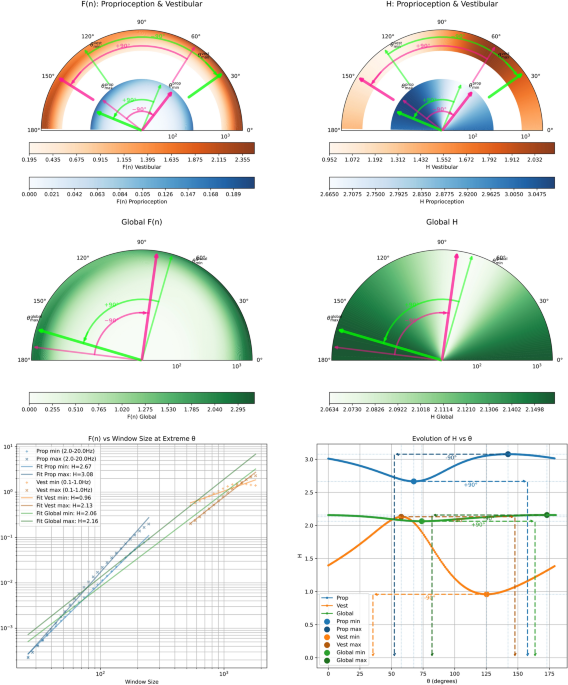
Postural instability is a disabling yet insufficiently characterized feature of Schizophrenia Spectrum Disorders (SSD). Quantitative posturography has consistently demonstrated increased body sway in SSD, which correlates with negative symptom severity and functional impairment; however, the sensorimotor mechanisms underlying these abnormalities remain poorly understood. This gap arises in part because conventional sway metrics neglect the multiscale, orientation-dependent organization of postural control.
To overcome these limitations, we introduce Frequency-Specific Oriented Fractal Scaling Component Analysis (FS-OFSCA), a novel method which partitions center-of-pressure (CoP) trajectories into physiologically motivated frequency bands associated with proprioceptive and visual-vestibular processing. Within each band, FS-OFSCA identifies the planar directions of strongest and weakest long-range temporal correlations. We applied this approach to CoP recordings obtained from 42 individuals with SSD and 33 Healthy Participants (HP), across 12 stance conditions.
The central result is that SSD is characterized less by how much participants sway than by a stance- and band-specific reorganization of the directional geometry of sway. Using linear mixed-effects models of the inter-axial angle (\(\Delta \theta\)), SSD showed a compression of \(\Delta \theta\) that was statistically supported at the overall-group level in the global band (\(p = 0.001\); Holm-adjusted \(p = 0.003\)); in the visual-vestibular and proprioceptive bands the overall group effect was not significant and the difference was stance-dependent. The coupling between \(\Delta \theta\) and directional fractal descriptors (\(H_1\), \(H_2\), \(SD_H\)) further differed between groups in a band-dependent manner.
By comparison, conventional geometric, spectral, and entropy-based metrics also separated the groups, with small-to-moderate effect sizes (Hedges’ \(g \approx 0.1-0.5\)) concentrated under sensory-challenging conditions; FS-OFSCA captures a complementary, directional aspect of postural control rather than information categorically unavailable to those metrics. To support reproducible posturography, we release STABLE, an open-source Python toolkit integrating linear, spectral, nonlinear, and anisotropic analysis methods. Schizophrenia Spectrum Disorders (SSD) are complex psychiatric conditions with a multifaceted clinical phenotype.
Alongside the canonical triad of positive, negative, and cognitive symptoms1, a wide range of motor abnormalities2,3,4 and postural control deficits5,6 are also commonly reported. Balance impairments are observed even in unmedicated patients2, underscoring their independence from antipsychotic exposure. These impairments are associated with increased morbidity, reduced functional autonomy, and lower quality of life7, emphasizing the need for systematic assessment and targeted rehabilitation strategies7,8.
Despite their clinical relevance, the neurophysiological mechanisms driving these balance impairments remain incompletely understood. Converging evidence implicates disruptions in cerebellar, vestibular, and multisensory integration pathways, which are essential for coordinating visual and proprioceptive inputs to maintain postural stability3,9. Quantitative posturography consistently demonstrates increased postural sway in individuals with SSD10.
Extract — continue reading at the source.


