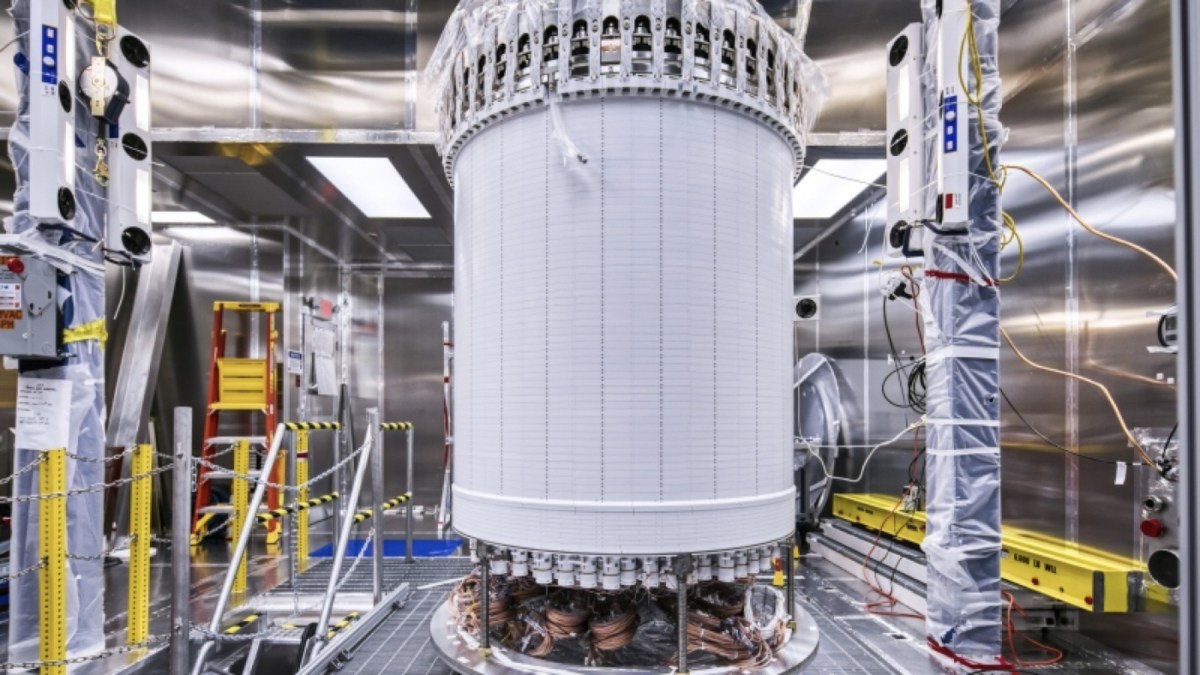
Scientists may have found the strongest sign yet of dark matter after a detector deep underground recorded an event that researchers cannot explain. Dark matter is the name given to an invisible substance believed to make up about 85 percent of all matter in the universe. Scientists cannot see it, but they know it is there because its gravity helps hold galaxies together.
Despite nearly a century of searching, NASA says scientists have never directly detected what dark matter is made of. LUX-ZEPLIN, or LZ, a detector located almost a mile underground in South Dakota, recorded the unusual event. The experiment contains a large tank of liquid xenon and is designed to spot the rare moment when a possible dark matter particle hits an ordinary atom.
Researchers found the event while examining 220 days of data collected between March 2023 and April 2024. It appeared in a part of the detector where scientists expected dark matter to show up and where interference from known sources was very low, according to Lawrence Berkeley National Laboratory. The team calculated that there is about a 1-in-200 chance that known background activity caused the event.
While that makes it unusual, the evidence is not yet strong enough to declare a discovery. Researchers presented the findings at a scientific conference in Japan on Tuesday. The paper is expected to be released online and submitted to Physical Review Letters.
Researchers stressed that they recorded only one unexplained event. It could be the first hint of a dark matter particle, but it could also have come from a rare source that scientists have not yet identified. More data will be needed to tell the difference.
In 1933, astronomer Fritz Zwicky noticed that galaxies in the Coma Cluster were moving too quickly to be held together by the matter he could see. He suggested that an invisible form of matter was providing the extra gravity, calling it “dark matter,” according to NASA. The idea gained wider acceptance in the 1970s through the work of American astronomer Vera Rubin.
Extract — continue reading at the source.