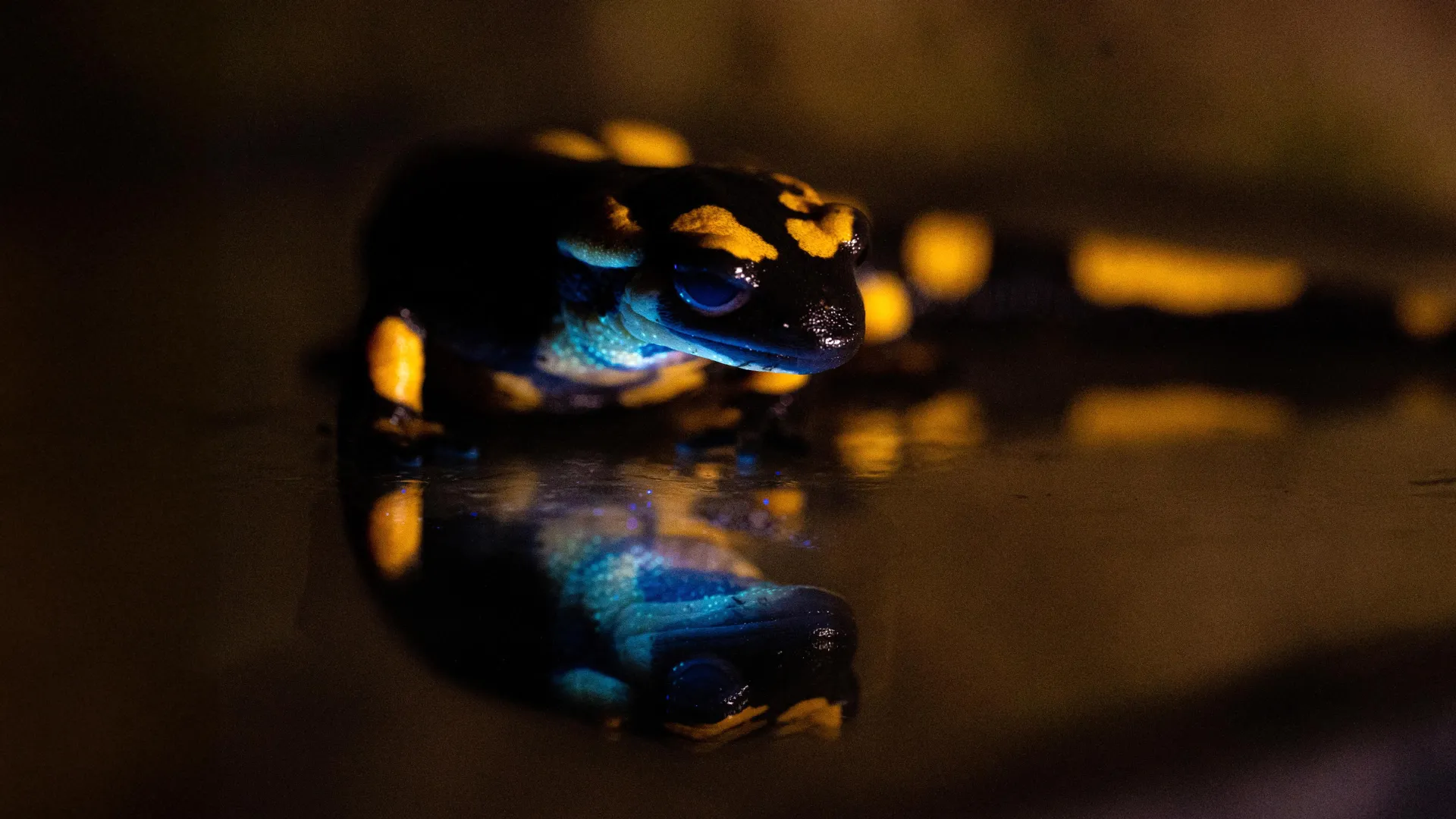
Fire salamanders are among Europe's most recognizable amphibians, known for their striking black and yellow coloring and the poisonous substances they release to deter predators. Despite their familiar appearance, scientists are still uncovering surprising details about their biology. The International Union for Conservation of Nature (IUCN) classifies the species as "vulnerable" on its Red List of Threatened Species.
Fire salamanders typically inhabit damp forests, streams, and mountainous regions, where habitat destruction and fragmentation increasingly threaten their survival. New research has revealed that fire salamanders possess an unexpected ability to fluoresce under ultraviolet light. The glow is most pronounced on the yellow underside of their bodies and along their sides.
Researchers traced the fluorescence primarily to glands in the animals' skin and the substances those glands release. Remarkably, these secretions can remain fluorescent for more than 24 hours after leaving the salamander's body. "It is fascinating that such a well-studied species still harbors unknown phenomena like this.
It reminds us that even the most familiar organisms can hide secrets that are only revealed when they are observed with new tools," says Bernat Burriel, a researcher at the Museum of Natural Sciences in Barcelona and the study's first author. The phenomenon occurs when compounds in the salamander's skin absorb ultraviolet light, which humans cannot see, and reemit that energy as visible light. This process produces vivid green and cyan colors.
Known as biofluorescence, it requires an outside source of illumination and should not be confused with bioluminescence. Animals such as fireflies produce their own light through chemical reactions, while fluorescent organisms must first absorb light from their surroundings. Scientists once believed that biofluorescence occurred almost exclusively in marine organisms, with scorpions standing out as an unusual example on land.
More recent studies have challenged that assumption, identifying fluorescent properties in a growing variety of terrestrial animals, including reptiles, birds, and amphibians. Although researchers have confirmed that fire salamanders fluoresce, the biological purpose of this ability remains uncertain. One possibility is that the glow serves as a form of communication, helping individuals recognize one another or assess potential mates.
Extract — continue reading at the source.


