Uncovering this hidden structure could eventually allow researchers to design superconducting materials and devices with greater control and precision. As scientists pursue quantum computers, ultra-efficient electronics, and other advanced technologies, a detailed understanding of how electrons behave inside superconductors will become increasingly important. Some scientific surprises emerge not from discovering something entirely new, but from taking a closer look at something researchers thought they already understood.
For decades, physicists have investigated superconductors—materials capable of carrying electrical current with zero energy loss. Their unusual properties could eventually support technologies ranging from ultra-efficient electronics and quantum computers to advanced medical systems. One of the best-studied examples is niobium diselenide (NbSe2).
When researchers reduced the material to only a few atomic layers, experiments appeared to show relatively simple superconducting behavior. In particular, the material seemed to have a single energy gap, a key characteristic that reflects how electrons pair together so they can move without electrical resistance. Researchers, however, had reason to suspect that this simple picture was incomplete.
The study was led by PhD. student Shahar Simon and MSc. student Maya Klang under the guidance of Prof. Hadar Steinberg of the Racah Institute of Physics and the Center for Nanoscience and Nanotechnology at the Hebrew University of Jerusalem. The research was published in Physical Review Letters.
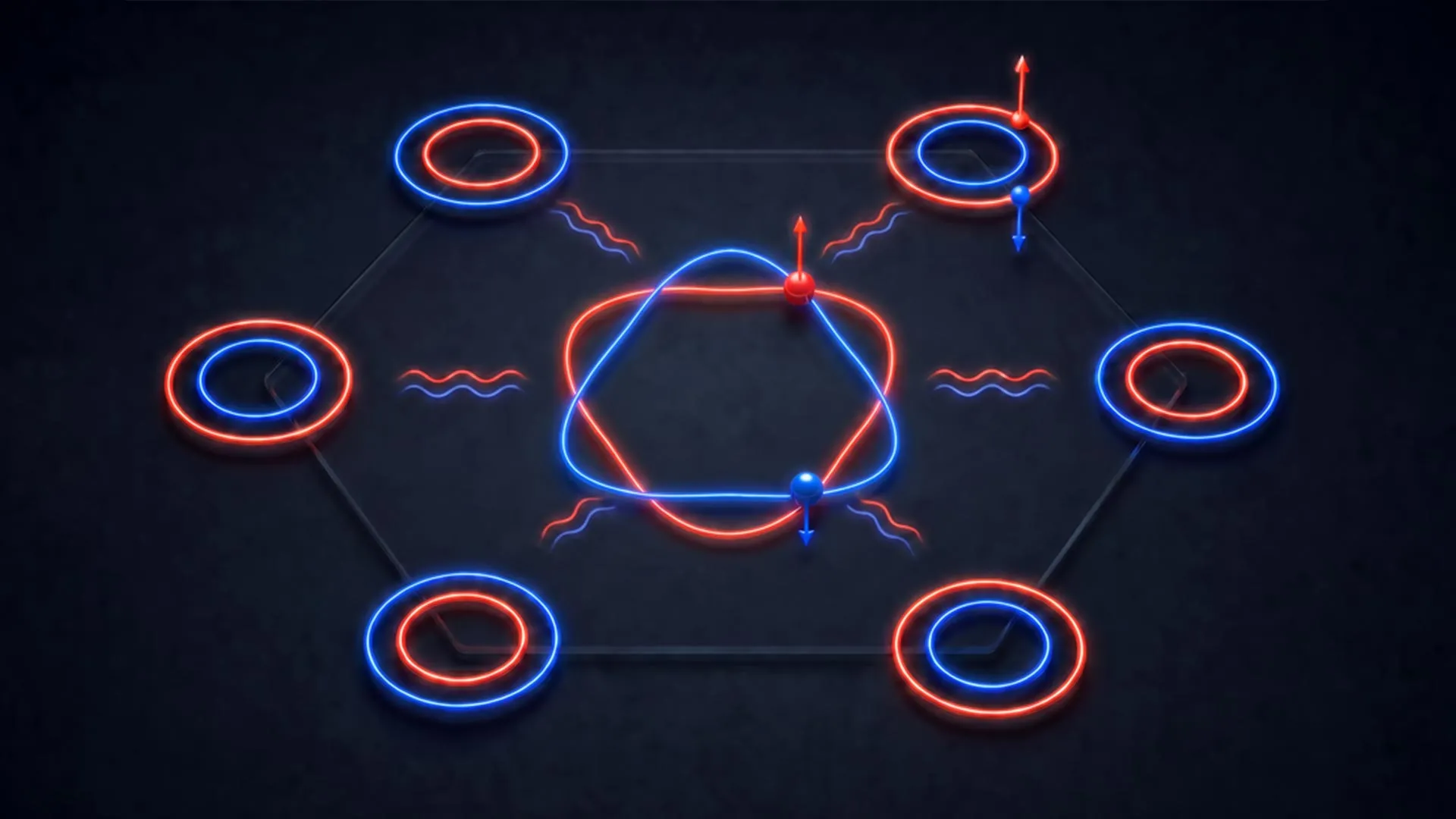
With highly sensitive tunneling spectroscopy measurements, the researchers found that NbSe2 does not behave like a straightforward superconductor governed by only one superconducting order. Instead, it contains two different superconducting orders that interact so strongly they appear as one. The researchers identified the same concealed behavior in the closely related material TaS2.
"It's a bit like listening to what sounds like a single singer, only to discover it's actually a perfectly synchronized duet," said the researchers. The finding provides an explanation for a puzzle that had remained unresolved for years. Traditional theories could not fully reproduce the detailed shape of the superconducting energy spectrum seen in earlier experiments.
Extract — continue reading at the source.