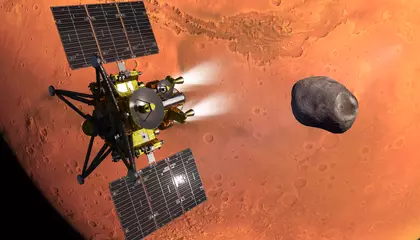
The Japan Aerospace Exploration Agency (JAXA) is sending a spacecraft toward Mars to help solve an enduring mystery of the solar system: Where did the Red Planet’s two lunar companions, Phobos and Deimos, come from? JAXA’s Martian Moons eXploration (MMX) probe launched from the agency’s Tanegashima Space Center in southern Japan on October 20 at 4:41 a.m. local time (October 19 at 3:41 p.m. If all goes according to plan, the Japan-led mission will bring samples from Phobos, the larger of the lunar duo, back to Earth in five years.
These precious bits of dirt could finally reveal how the moon and its smaller sibling came to be, while also shedding light on Mars’ history. One posits they may have formed the same way Earth’s own moon formed: Something slammed into Mars and shot tons of material into space, which eventually coalesced into the two moons. (Why this would have birthed dual mini moons, rather than a single large one like Earth’s, remains an open question.) The other possible explanation suggests that the two bodies were asteroids sucked into Mars’ orbit millions of years ago, according to a statement from NASA, which is contributing to MMX. Other collaborators include the European Space Agency, France’s National Center for Space Studies, the German Aerospace Center and the Australian Space Agency.
Mars’ moons are quite tiny: Deimos is 7.5 miles wide, and Phobos is 14 miles wide. For comparison, Earth’s moon is 2,159 miles wide. Both scenarios carry significance for understanding their host planet.
If Phobos formed from Martian debris, it could be made of material from Mars’ earlier days, when the Red Planet may have been better predisposed to host life than it is now, according to a JAXA statement. On the other hand, if Phobos hails from the far reaches of the solar system, it may have brought along water-bearing minerals and organics that could’ve helped birth life on Earth. Scientists are hoping that the MMX mission, which is slated to reach Mars’ system in August of next year, will help solve the matter.
The spacecraft will first investigate Phobos from orbit before landing on the moon’s surface twice in separate locations to collect the highly anticipated samples. The MMX probe will also investigate Mars from a distance and perform flyby observations of Deimos. Landing operations are very risky.” The mission will collect samples on Phobos via two instruments.
One will collect ground surface samples by acting like a vacuum cleaner. It’ll emit bursts of high-pressure nitrogen gas to loosen the dirt and suck up the disturbed regolith. The other sampler will pull cores from a few inches deeper in the ground.
Extract — continue reading at the source.