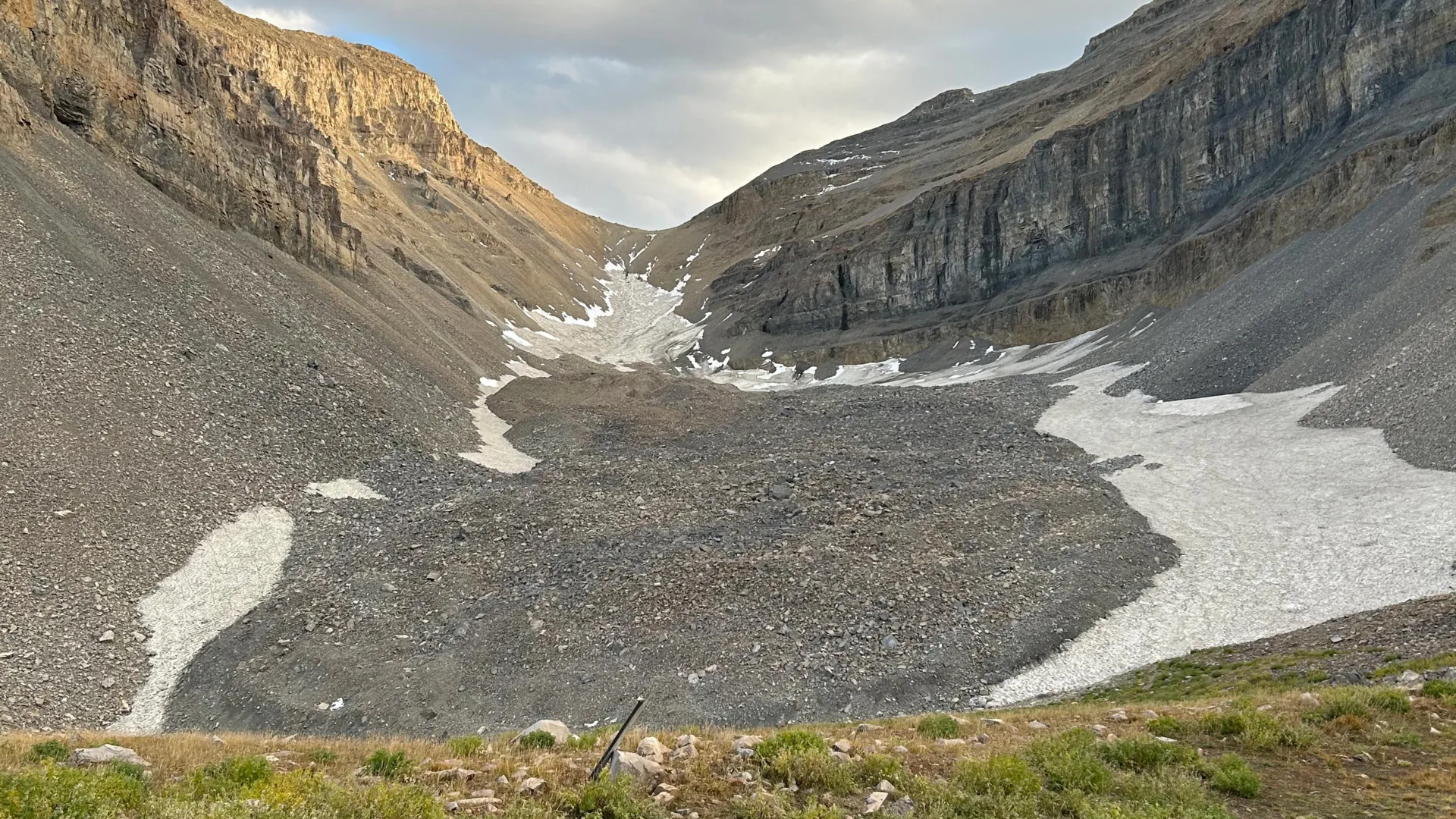
Rock glaciers look very different from conventional glaciers. Instead of exposed ice, they resemble sprawling fields of loose rock, while potentially concealing large quantities of ice below the surface. These formations are widespread across Utah's Wasatch and Uinta ranges and can also be found on the Colorado Plateau in the La Sal Mountains near Moab.
University of Utah geologists have now taken a detailed look inside one of the state's largest examples, the Timpanogos Rock Glacier beneath the prominent summit of Mount Timpanogos near Salt Lake City and Provo. Two new studies examine how the glacier formed and reveal how much ice is buried inside it. By detecting extremely small differences in the gravitational pull of rock and ice, the researchers developed a new way to create a 3D image of the hidden ice within a large rock glacier.
The results show that Timpanogos Rock Glacier contains about 1.5 million cubic meters of frozen water, enough to fill roughly 600 Olympic swimming pools. Bronson Cvijanovich, a former graduate student in the Department of Geology & Geophysics, noted that this is also about the same volume as the largest pyramid at Giza in Egypt. "Timpanogos Rock Glacier is surprisingly ice rich.
It is 83% ice and 17% loose rock," said Cvijanovich, lead author of one of the two studies overseen by geophysics professor Michael Thorne and glaciology professor Leif Anderson. "There's a lot of ice that's hidden in Utah's mountains," Anderson said. "When we are high in the mountains and walking across loose rocks or rubble, you don't realize there could be 120 feet of ice buried beneath your feet." During the fall of 2024, Cvijanovich led a series of field trips to Timpanogos Rock Glacier, carrying sensitive equipment to the buried ice above Emerald Lake.
Among the instruments was a state-of-the-art gravimeter. Across six trips, he collected gravity measurements at 232 locations arranged in a grid across the glacier, with each point separated by 25 meters (~80 feet). A gravimeter can detect differences in density, allowing researchers to distinguish the denser surrounding rock from the much lighter buried ice.
Those measurements can then be used to estimate the shape and thickness of the hidden glacier. "There is a large contrast in mass density between the rock that makes up Mount Timpanogos and the much lower density ice that is in rock glacier adjacent to it," Thorne said. "When we measure the gravitational acceleration over the rock glacier, we see a larger decrease in that gravitational acceleration as we make measurements over areas with thicker ice." Collecting the gravity data was only the first step.
Extract — continue reading at the source.