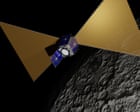
Little is known about what was happening shortly after the big bang, but now researchers are hoping to shed fresh light on the matter by harnessing the dark side of the moon. Scientists are hoping to put a suitcase-sized satellite into orbit around the moon, using the data it collects as it passes the far side to search for a radio frequency signal emitted by neutral hydrogen atoms in the early universe. More specifically, the satellite, nicknamed CosmoCube, will be looking for what is known as the 21cm line.
Crucially, the older the signal, the more its wavelength has been stretched, or redshifted, to longer wavelengths, providing a way for its strength to be tracked over time relative to the cosmic microwave background radiation. With the 21cm signal acting a bit like a thermometer, the team are hoping to study events from the start of the so-called “dark ages”, about 380,000 years after the big bang, through the cosmic dawn, when the first stars and galaxies emerged, to the end of what is known as the epoch of reionization, approximately 1bn years after the big bang. In addition he noted the amplitude and shape of the 21cm signal was expected to be influenced by dark matter, offering a way for experts to investigate the nature of this mysterious component of the universe.
Researchers have attempted to detect the 21cm line before. However, it is difficult to do using Earth-based instruments. Not only is the signal very weak but human-made technology – from FM radios to plane communication – can cause interference.
Writing in the journal Nature Astronomy, de Lera Acedo and colleagues said other challenges iincluded disturbances created by the Earth’s ionosphere. While experts at the EDGES (Experiment to Detect the Global EoR Signature) radio telescope in Australia have claimed to have found the 21cm line, questions have been raised over the results. The team behind the CosmoCube mission, which is expected to last two years, said taking observations from the far side of the moon should avoid many of the challenges faced by Earth-based instruments.
Phil Bull, a professor of cosmology at the Jodrell Bank Centre for Astrophysics who is not involved in the project, welcomed the mission. But, Bull noted CosmoCube was not the only mission trying to make these measurements, and others might get there first. Purchase your ticket here.
Extract — continue reading at the source.