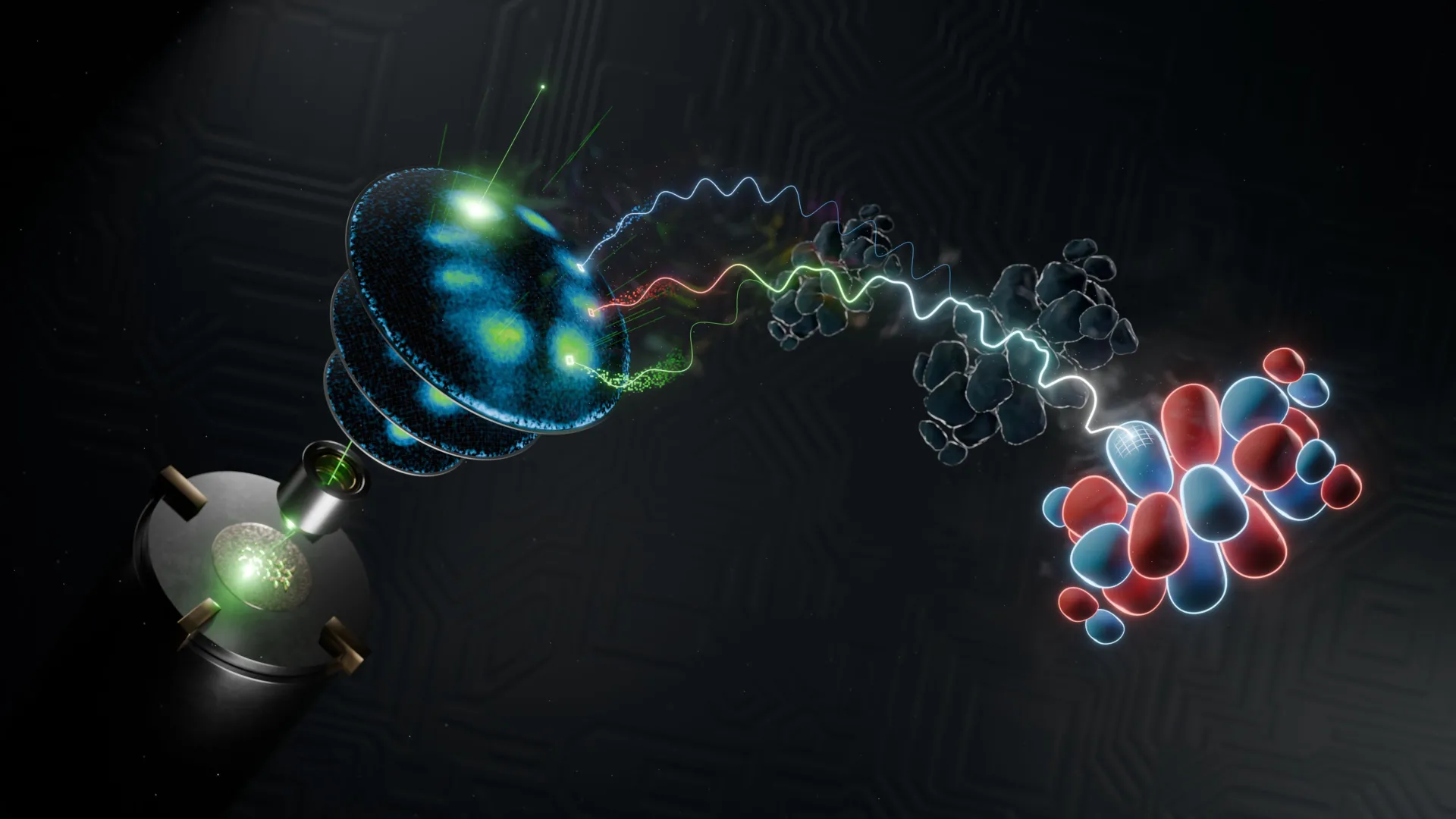
Quantum mechanics has long challenged the familiar idea that an object must occupy one precise place at a given moment. Fundamental particles such as electrons are instead described by a "wavefunction," a mathematical representation that researchers can use to calculate the probabilities of properties such as position and momentum. Inside molecules, electron wavefunctions are known as "molecular orbitals." These orbitals contain valuable information about how a molecule behaves and interacts with its environment, including how it absorbs light and how chemical reactions may unfold.
Obtaining a complete three-dimensional picture of a wavefunction would therefore give scientists a powerful view of molecular behavior, but producing such an image has been extremely difficult. Now, an interdisciplinary team at the University of Göttingen has successfully imaged the three-dimensional wavefunction of an organic molecule only nanometers in size. The researchers accomplished this by combining advanced photoelectron spectroscopy with sophisticated mathematical algorithms.
Their findings were published in Nature Communications. Reconstructing an Elusive Quantum Wavefunction "The wavefunction is a fundamental quantity in quantum mechanics, yet it cannot be directly observed or measured," explains Professor Stefan Mathias at the University of Göttingen. Because the wavefunction itself cannot simply be measured, the researchers used an indirect technique called photoelectron spectroscopy.
The method measures the momentum of electrons emitted from the molecule, giving scientists access to one half of the wavefunction without physically changing its state. Advanced computer algorithms were then used to reconstruct the missing half. This allowed the team to produce an image of the complete molecular orbital and distinguish features that are even smaller than the distance separating the carbon atoms within the molecule.
Until now, extending this approach into three dimensions required lengthy measurements at major synchrotron research facilities. That requirement made the technique difficult to use widely and created an especially large obstacle for efforts to image "dynamical" wavefunctions as three-dimensional videos at atomic scales. Matthijs Jansen, University of Göttingen, and co-leader of the study, highlights the originality of the team's approach: "We introduce two powerful new concepts.
First, by redesigning the computer algorithm from the ground up, reliable 3D images can now be obtained using much less experimental data. Second, the experiment is based upon a powerful, lab-based soft-X-ray light source that provides ultrashort light pulses. It is the combination of these two techniques that has this remarkable impact." The redesigned algorithm dramatically reduces the amount of experimental data required to generate dependable three-dimensional images.
Extract — continue reading at the source.


