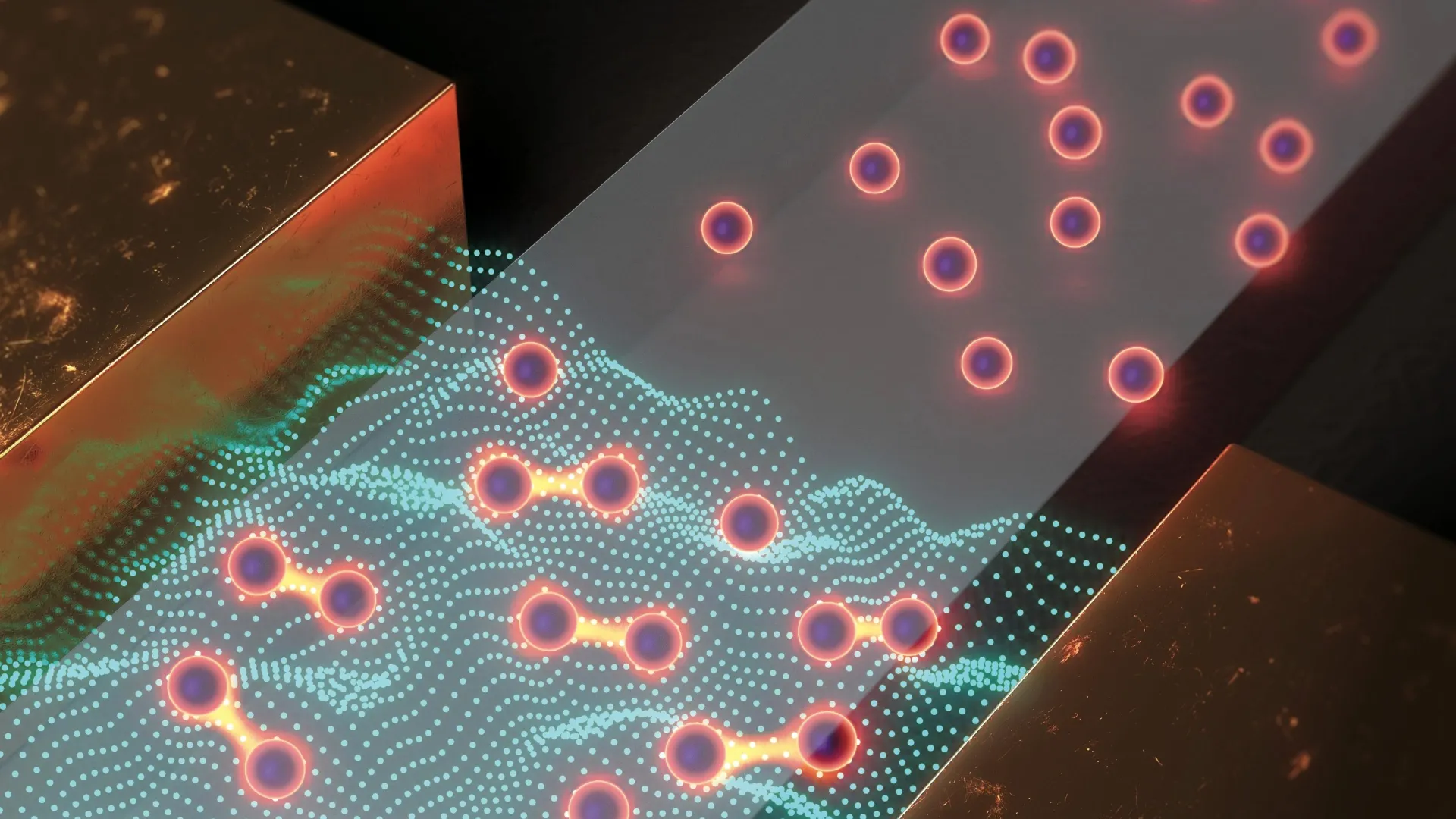
Researchers have demonstrated for the first time that quantum fluctuations in a vacuum can strengthen superconductivity, opening a new path for controlling unusual states of matter. The study, published in Nature, was led by Profs. Changgan Zeng and Guanghui Cheng of the University of Science and Technology of China of the Chinese Academy of Sciences.
The collaboration also included Prof. Qingdong Jiang of Shanghai Jiao Tong University, Prof. Frank Wilczek of the Massachusetts Institute of Technology, and other researchers.
In everyday language, a vacuum may sound like completely empty space. Quantum physics paints a very different picture. According to quantum electrodynamics and the Heisenberg uncertainty principle, even the lowest energy state is never perfectly still.
Virtual particles continually appear and disappear, producing an ever present background of quantum fluctuations. These fluctuations are not merely theoretical. Their effects have been observed through well established phenomena such as the Lamb shift, spontaneous emission, and the Casimir effect.
For several years, the teams led by Zeng and Cheng have investigated how these vacuum fluctuations affect condensed matter systems. In an earlier study, the researchers showed that they could directly manipulate vacuum fluctuations by using a magnetic field to reversibly switch the Casimir force between attraction and repulsion. That result raised a larger question: Could quantum vacuum fluctuations also be used to control macroscopic quantum states?
Jiang's group has approached the same problem from a theoretical perspective, studying how engineered quantum vacuum environments could influence different states of matter. The researchers introduced the concept of "vacuumronics," in which specially designed vacuum environments are used to control electronic and photonic behavior. That theoretical work helped provide a framework for understanding the superconductivity enhancement observed in the new experiments.
Extract — continue reading at the source.


