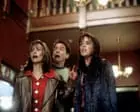
The 30th anniversary re-release of the original Scream, from screenwriter Kevin Williamson and director Wes Craven, brings us to a locus classicus of the 90s: a self-aware romp through the horror genre. It features Skeet Ulrich’s high schooler Billy Loomis announcing that reality is “all one big movie – but you can’t pick your genre”, which is the meta-slasher equivalent of Jacques Derrida’s belief that there is nothing outside the text. A ghost-masked killer is murdering and terrorising the bland Californian town of Woodsboro, and we begin with his gruesome assault on Casey (Drew Barrymore); he makes chilling calls to people’s landline phones, in an era where that meant you more or less had them pinned them down to a certain location. (The existence of “cellular” phones was still an exotic novelty.) The mother of teen Sidney (Neve Campbell) had been brutally killed previously, a crime pinned on local man Cotton Weary (a cameo for Liev Schreiber) who is now in jail.
But was he really guilty? Now Sidney is at risk like everyone else. Yet as one of the local horror fans points out: you’re safe as long as you stick to the three scary-movie rules: stay a virgin, avoid drink and drugs, and don’t utter the hubristic phrase “I’ll be right back”. (Perhaps someone could also have pointed out the difference in vulnerability-level between blondes and non-blondes.) So when Sidney has sex, she puts herself in mortal danger.
Meanwhile, brash local TV reporter Gale Weathers (played by Courteney Cox, already a star from Friends) figures she can crack this case wide open, and she has a tendresse for the goofy young cop deputy Dewey Riley, played by Cox’s future husband, David Arquette. The self-aware references are many, and the action of Scream is often wittily juxtaposed with narrative sequences from a classic such as Halloween. What comes across from watching the original Scream 30 years on is that there is one horror classic that could be an influence but isn’t referenced, perhaps because it isn’t canonical in the purist slasher-film sense: Truman Capote’s reportage history In Cold Blood. (I think of this, when one character here dismisses the idea of “motive”.) What also emerges, perhaps not entirely intentionally, is how very obnoxious, and very possibly sadistic, male movie fandom can often seem in itself.
It’s very apparent when the killer smugly challenges his victim with a trick question about who the killer is in the first Friday the 13th. This film is brash and smart in that distinctive 90s way – and the title sounds like an order.
Extract — continue reading at the source.