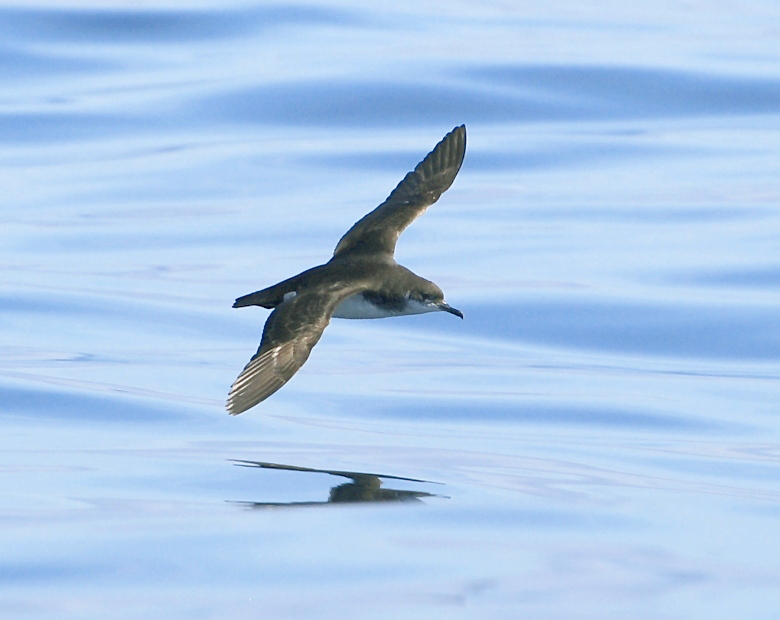
A long flight home from feeding grounds messes with birds’ internal clocks. Flying across several time zones often causes jet lag, a feeling when the body insists it’s the middle of the night while the clock says it’s lunchtime. Now it turns out this nuisance is not exclusive to humans.
A new Science study on Manx shearwaters, seabirds that can fly hundreds of kilometers a day over the North Atlantic, shows they jet-lag themselves during their excursions. And because these birds navigate by the Sun, that jet lag leaves a measurable mark—it skews their compass. Patrick Lewin is a behavioral and sensory ecologist at the University of Oxford and lead author of the study.
Most breed around the UK and Ireland, with about half of their population living in Wales. From there, they head out to feed anywhere from a few dozen to more than 1,000 kilometers into the Atlantic. To get back, shearwaters are thought to work out where they are located using a map sense, possibly based on smells, and then use the Sun as a compass to set their direction.
The trouble with navigating by the Sun, though, is that it moves across the sky. At sunrise, when the Sun’s in the east, it needs to be traveling 90 degrees clockwise of the Sun, but by midday it needs to be traveling straight towards the Sun, and by sunset it needs to be traveling 90 degrees anticlockwise of the Sun,” Lewin said. Effective navigation by the Sun requires a clock that tells you what time of day it is.
Birds, like nearly all animals, have such a clock built in. But the clock in Manx shearwaters is not perfect. The birds recalibrate their internal clock at every dusk and dawn.
This means that for every degree of longitude a bird covers between sunrise and sunset, its clock falls four minutes out of sync with local time. In consequence, a Manx shearwater misjudges where the Sun should be and veers off course clockwise when it flies east, or anticlockwise when it flies west. Scientists had already shown something similar in other birds by catching penguins and quickly moving them across lines of longitude, but before Lewin’s study no one had clearly demonstrated it in wild animals moving on their own, mostly because the effect is small, and so requires a _lot_ of data to become apparent.
Extract — continue reading at the source.