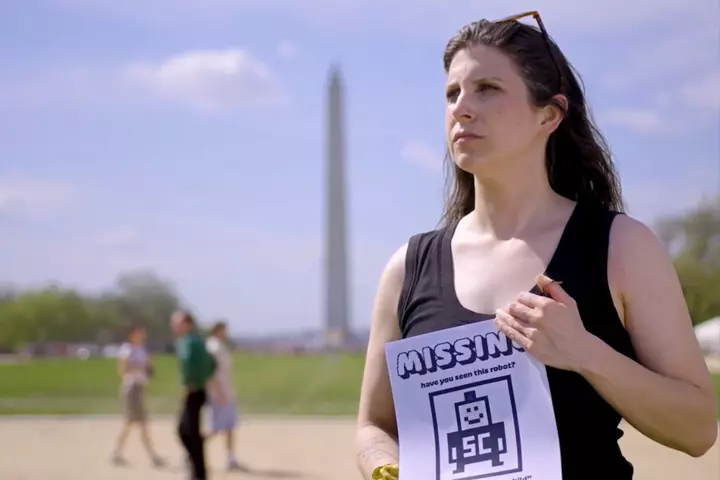
Why do humans tend to vent abuse at their AI bots – and should they think about apologizing? That question is central to “Searching for SmarterChild,” the project that won the New Visions Award for the most promising U.S. project at the Ji.hlava Documentary Film Festival this week. Zan Gillies is co-directing the U.S.-Canadian film with Lindsey Sitz, a Pulitzer-winning journalist.
It is produced by Erin Williams-Weir. SmarterChild, for those who may have missed the moment two decades ago, was one of the most popular early chatbots in North America, available to millions of households that subscribed to AOL, Yahoo and other platforms. Some 3 million people engaged with SmarterChild through text messages – often in conversations that were markedly rude, says Gillies.
One guy specifically said, ‘Oh yeah – I was so mean to that bot.’” At the film’s core, says Gillies, is the question “What does our relationship with artificial intelligence reveal about ourselves?” Though chat technology has evolved rapidly since the early days of the internet, the questions surrounding our interactions with it remain the same, Gillies says. What is our relationship to these things? Are they our therapists, or assistants or lovers or whatever?” The co-directors have found that other early chatbot experiences around the world reflected those in North America, says Gillies, with users in Korea and beyond also dumping on text platforms with insults.
The project idea came into focus when Gilles and Sitz realized two years ago that each of them had, while younger, used SmarterChild…and indeed had both been abusive to the bot. Typically, the early AI software would ask the user’s favorite hobby, and would receive a hostile response like, “Setting things on fire.” It then would politely suggest an alternate activity before being told something like, “Setting YOU on fire.” These responses were actually Gillies’ own words, as he discovered after tracking down the inventors and engineers behind SmarterChild, who still have digital records of every chat session. Text conversations often went downhill from this kind of opening.
The filmmakers have so far filmed interviews with members of both the West Coast team and the East Coast team, which composed the responses language for SmarterChild, before it was sold off to Microsoft and shut down. After its initial success, engineers in Silicon Valley were surprised at how abusive users were and convened emergency meetings to deal with the issue, Gillies says. They decided to add a feature allowing SmarterChild to recognize rude language and respond with warnings – and even a degree of snark.
If it continued, the bot would go into temporary shutdown until the user apologized. Gillies was surprised to learn in researching the docu that the programmers came up with a rating system for calculating the relative weight of insults. Gillies and Sitz have so far raised about $18,000 on crowdfunding platforms for their docu, which they expect to be about a fifth of its final budget.
Extract — continue reading at the source.