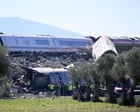
Spain’s high-speed rail network, the most extensive in Europe and the second largest in the world after China, has long been a point of pride in the country. But Wednesday’s deadly crash – the second in nine months – has recast the spotlight on questions about safety. Officials said at least 68 people were killed on Wednesday morning after a high-speed train slammed into another that had stopped on the tracks, leading to the derailment of several carriages.
The two trains were believed to be carrying 544 passengers. Speaking to reporters, Spain’s transport minister, Óscar Puente, traced the collision back to a security system that had stopped working at about 8.30am local time. The computer malfunction brought an estimated six trains to a halt along a 63km stretch of track.
Soon after, the central command in Madrid instructed one of the trains involved in the crash to resume service at normal speeds, sending it colliding into a train that was still sitting stationary on the tracks, said Puente. State-owned rail operator Renfe said in a statement that its train had been instructed to continue on its way and had crashed into the stationary Iryo train “for reasons we don’t know”. The accident follows a crash in January that killed 46 people and left dozens more injured near the town of Adamuz in Andalucía.
Media on Wednesday were swift to point to the parallels between the two crashes: both involved the same train operators and took place on the line connecting Madrid to the southern region of Andalusia, which is the oldest on Spain’s high-speed network. The first crash sparked conversation over safety on the line, a debate that rail unions say has continued. Wednesday’s disaster came a day before a planned 24-hour work stoppage at Renfe by Spain’s largest train drivers union.
Their reasons for taking action ranged from the need for climate emergency protocols to ensuring channels of communication for workers to convey concerns. The union also called for guarantees that trains would be “reliable and safe”, adding: “We demand real and definitive technical solutions to the safety and reliability issues that have long plagued our rolling stock.” It has also called a rolling, six-day strike for drivers at the high-speed rail operator Ouigo. The January crash sparked a bout of political finger-pointing over whether Pedro Sánchez’s Socialist party government had spent enough on railway maintenance in a country where travel by train accounts for about 57% of all transport.
While the causes of the January crash remain under investigation, a preliminary report suggested that it could have been the result of defects in the track or in a weld between two sections of track. The report noted, however, that several other possibilities were also being investigated. Train travel grew by 40% from 2019 to 2024, coinciding with a period in which the country opened up its rail network to private companies.
Extract — continue reading at the source.