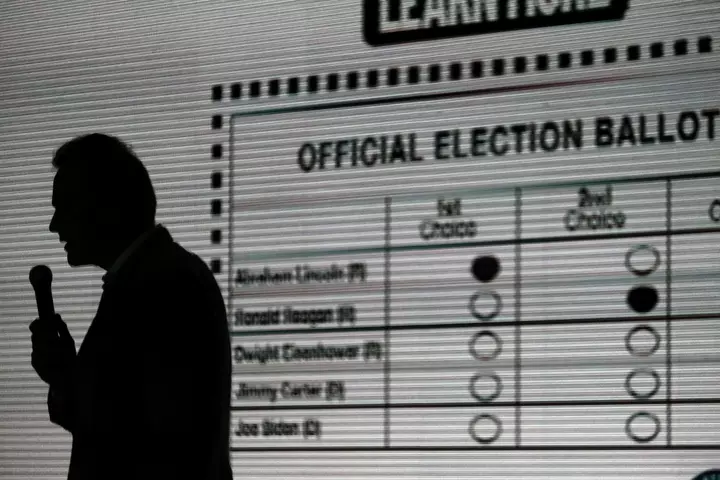
Alaska's 2026 Senate race is not only one of the country's most competitive contests, it is also a referendum on one of the most closely watched election experiments in America: ranked choice voting. Alaska first adopted the voting system in 2020 and first used it during the 2022 midterms. Voters narrowly rejected repealing the system in 2024 and are being asked once more whether to keep it, with the outcome holding the potential to influence election reform debates nationwide.
"The system Alaskans adopted in 2020 fits the way Alaskans actually vote," Ruth Hall, deputy campaign manager at No On 2, which is fighting to keep the RCV system in place, told Newsweek. "Sixty-four percent of Alaskans don’t belong to a political party. When the system was first implemented in 2022, more than half Alaskans split their ticket in the primary between candidates of different party affiliations." Rather than the traditional way voting takes place elsewhere in the U.S., with voters marking the one candidate they want to elect, ranked choice voting (RCV) allows voters to rate all candidates from first to last choice, funneling those results into a two-person race which then leads to a final result, which can take several days to be announced.
For example, if Peltola won 45 percent of the vote, Sullivan 40 percent and the two other candidates on the ballot 10 and 5 percent respectively, no one candidate has over 50 percent, or a majority. The lowest-ranked candidate would be eliminated. The ballots which ranked that candidate first would then have their second choices split among the respective candidates, and so on until either Peltola or Sullivan pass the threshold.
Newsweek reached out to the Sullivan and Peltola campaigns, and the Alaska Division of Elections for comment Tuesday. Senate race has been framed as between incumbent Dan Sullivan, a Republican, and Mary Peltola, a Democrat, but there is another candidate also on the ballot—Dan J. Sullivan, another Republican also running against Dan S.
In the state's August primary, which covered all parties, Peltola led with 49.5 percent of the vote, followed by the current senator on 41.4 percent. According to FairVote, which is pro RCV, some Republicans have raised concern that the other Sullivan's appearance on the ballot will lead to a loss of votes for the incumbent. The group argues RCV mitigates the problem, as any voters uncertain about which Sullivan is which can rank both of them.
Recent polling from Alaska Survey Research and AARP have included a RCV element, with Peltola taking the lead in both initial votes and the final round. The time it takes to move through the different rounds of ballot counts could leave Senate control waiting on Alaska's result, as a key state Democrats are hoping to flip after more than a decade of GOP domination. "Alaska’s election system is delivering for the state.
Extract — continue reading at the source.