Serbia’s parliamentary elections on Sunday, October 25 delivered a political earthquake. The Student List movement challenged the Serbian Progressive Party (SNS) which had dominated Serbian politics for 14 years, led by outgoing president Aleksandar Vucic. The result marked a historic turning point: the Student List won 52.45 percent of the vote, securing 138 seats in the National Assembly, while the Aleksandar Vucic – United Serbia list received 39.2 , earning 103 seats.
The student movement emerged in the aftermath of the collapse of a railway station canopy in Novi Sad on November 1, 2024, a tragedy that claimed 16 lives and triggered nationwide protests against corruption. Initially non-partisan, the movement gradually gained widespread public support before deciding to field its own electoral list. Rather than running for office themselves, the students chose to nominate highly qualified individuals with no prior political experience, selected through a democratic process organised within universities.
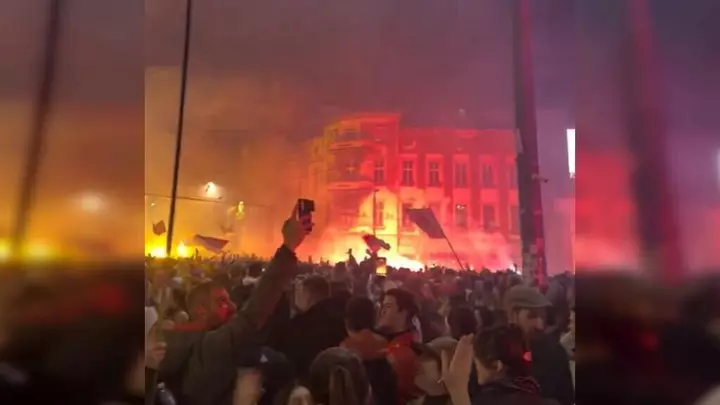
Student list supporters dance in front of the National Assembly in Belgrade in the evening of October 25, 2026 to celebrate their win at the legislative elections. Instagram/ ©bukamagazin To display this content from Instagram, you must enable advertisement tracking and audience measurement. **'We trained at least 16,000 people to become official controllers'** Petar Botoski, an agricultural student supporting the Student List, was in Novi Sad, a city located in the northern part of the country, when Aleksandar Vucic acknowledged the defeat of his party. > "It was the most challenging moment. We expected to win, but we did not know what would happen next.
When the announcement came, I was in shock, everyone was cheering. At that time, the votes were still being transferred and being counted." He explained that the student movement prevented much electoral fraud during the day. > “The whole day we reported to authorities incidents such as the finding of parallel lists or the detection of carousel votes.” Both are practices that can facilitate voter pressure or manipulation of the voting process. The parallel list is an unofficial list of voters used alongside the official register to manipulate or falsify voting records, while carousel voting is a form of electoral fraud in which a voter is given a ballot that has already been marked, takes it into the polling station and deposits it in the ballot box.
The voter then brings the unmarked ballot they received as proof that he or she voted as “required”. > “For a year and half, since we decided to propose a student list for the legislative elections, the student movement spent a lot of time and resources to create connections between people and to teach them how to prevent electoral fraud. > We trained at least 16,000 people to become official controllers, two for each polling station. Then we trained about five people per polling station to be part of mobile teams. Their mission was to detect fraud outside the polling stations, such as the use of parallel lists, carousel vote, pay[ing] for voters and intimidations. [Tracking] fraud had for sure an impact on the results.” Turnout reached 69 percent, with more than 4.4 million citizens casting their ballots.
This represents a significant increase compared with the 55.5 percent turnout recorded in Serbia’s December 2023 parliamentary elections. A video showing a huge queue outside a polling station in Novi Sad on October 25, 2026. ©Instagram/ @moj_pogled To display this content from Instagram, you must enable advertisement tracking and audience measurement. Janko Sikosek, a member of the movement “Bikers with Students”, was among the volunteers that assisted in monitoring polling stations and helping to ensure a fair and transparent electoral process. > “I went out to vote early in the morning; the line was already forming before the polling station opened.
Extract — continue reading at the source.