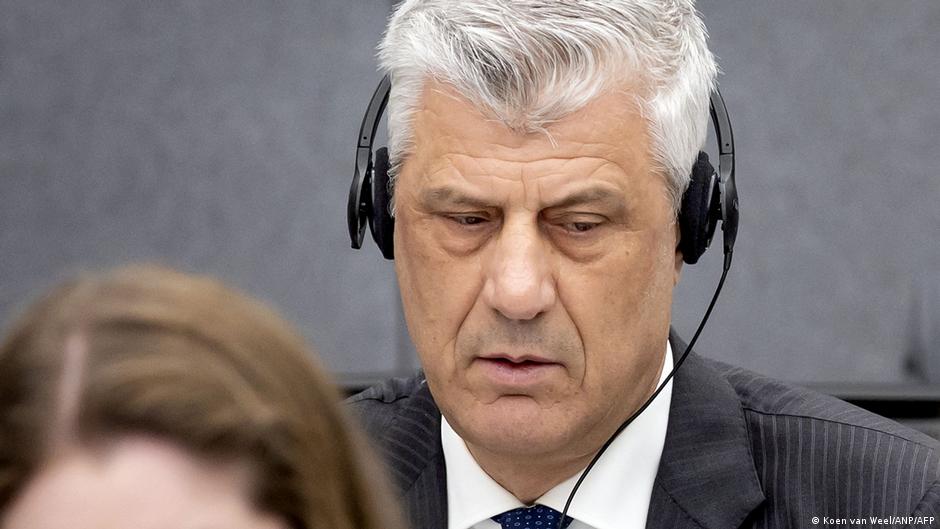
The Kosovo war crimes tribunal in The Hague on Wednesday found four former leaders of the Kosovo Liberation Army (KLA) guilty of war crimes committed during the 1998–99 Kosovo war. The war was fought between the forces of the Federal Republic of Yugoslavia and Serbia, on the one side, and the KLA on the other, and took place in the context of the breakup of the former Yugoslavia. Former Kosovo President Hashim Thaci and former KLA leaders Kadri Veseli, Rexhep Selimi and Jakup Krasniqi were sentenced at first instance by the Kosovo Specialist Chambers to a combined 81 years in prison: Thaci and Krasniqi to 25 years each, Veseli to 18 and Selimi to 13 years.
The four men were convicted of the arbitrary detention of 385 people, cruel treatment of 49 people, torture of 303 people and the murder of 96 people. They were acquitted of the charges of crimes against humanity on the grounds that it had not been proven that there had been a widespread or systematic attack directed against a civilian population. Speaking at a press conference on Wednesday evening, Serbian President Aleksandar Vucic criticized the fact that the Kosovo Specialist Chambers (which is part of Kosovo's judicial system but is based in The Hague and staffed by international judges) did not convict the four former KLA leaders of crimes against humanity.
"As a court of the so-called Kosovo, they did not want to undermine the credibility of the KLA and did not address the merits of the matter concerning the formation of forces aimed at seceding Kosovo from Serbia and the Federal Republic of Yugoslavia," he said. Vucic added that the verdict did not cover crimes committed against Serbs after June 20, 1999, when KFOR, an international peacekeeping mission led by NATO, arrived in Kosovo after the armed conflict had officially ended. Vucic had strong words on the reactions to the verdict from several states of the former Yugoslavia.
Commenting on Kosovo Prime Minister Albin Kurti's assessment that the verdict represented an "unacceptable injustice," Vucic said: "Imagine if we had said that about any defendant or convicted person. How many resolutions and declarations would various European and world parliaments have adopted against our people and our country?" This was an allusion to the condemnation by European officials of the funeral last week of former Bosnian Serb commander and convicted war criminal Ratko Mladic, which was attended by large numbers of citizens and several Serbian government ministers in Belgrade. To view this video please enable JavaScript, and consider upgrading to a web browser that supports HTML5 video Vucic also commented on a statement issued by Croatia's Ministry of Foreign and European Affairs, which said the verdict did not change the fact that the people of Kosovo had been victims of repression and crimes committed by Serbian leader Slobodan Milosevic's regime.
"There are no Serbs as victims; in every statement, Serbs have to be the perpetrators," said Vucic. "All of them in the region are united in hatred against Serbs." Serbian lawyer Aleksandar Olenik, who works on war crimes cases in the former Yugoslavia, gave a positive assessment of the ruling. "It is well known that war crimes were committed in the territory of Kosovo that was under the control of the KLA during the 1990s.
We now have judgments and the individualization of criminal responsibility," he told DW. Olenik pointed out that the respect shown for victims in the proceedings in The Hague represents "progress in international criminal law." "In previous ad hoc tribunals, victims were merely witnesses, merely a means of proving guilt. At this court, they have their own legal representative and are entitled to compensation," he said.
Extract — continue reading at the source.