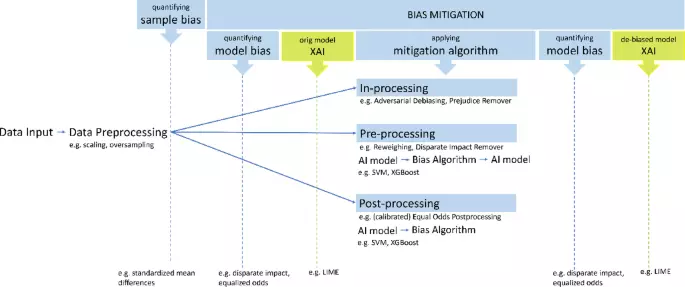
Sex and gender-related bias in clinical machine learning (ML) may contribute to inequitable diagnostic predictions in neurodegenerative diseases, where demographic factors may confound disease-related patterns. We developed and evaluated sex-debiased ML models for Alzheimer’s disease (AD) classification and their effects on model performance, fairness and interpretability. We analyzed 757 individuals suffering either from mild cognitive impairment (N = 600, 269 females) or AD (N = 157, 68 females) from the Alzheimer’s Disease Neuroimaging Initiative.
Sex was defined as the protected attribute. Four supervised ML algorithms were used to train classifiers based on demographic, genetic, neuropsychological, and MRI-derived features. For bias mitigation, methods of the IBM AI Fairness 360 framework were used.
Fairness and model performance were assessed before and after mitigation, with LIME and SHAP used to evaluate changes in feature attribution. Bias mitigation reduced sample bias with the statistical mean difference decreasing from − 0.017 to 0.004. Mitigating model bias, two models demonstrated favorable combinations of classification performance and fairness: Logistic regression with Disparate Impact Remover improved balanced accuracy from 85.16% to 88.08% while reducing e.g. the equalized odds difference (original = -0.036, debiased = -0.003) and yielded the highest number of previously misclassified patients who were subsequently correctly classified.
LIME analyses showed altered feature attribution patterns after mitigation including greater contributions from gender-related variables. The model achieving the highest balanced accuracy (88.91%) while maintaining favorable fairness metrics used Adversarial Debiasing. Adversarial Debiasing mitigates by reducing the influence of the protected attribute on model decisions.
SHAP identified the total scores of the Mini-Mental State Examination and Functional Assessment Questionnaire as the strongest predictors of AD, suggesting that clinically relevant disease-related features remained important after bias mitigation. These findings demonstrate that fairness-aware ML can reduce sex-related bias in AD classification without compromising classification performance. The complementary strengths of the two models highlight the value of tailoring bias-mitigation strategies to clinical objectives.
Integrating explainability may facilitate the development and responsible deployment of more transparent and equitable AI systems for neurodegenerative disease diagnosis. Data collection and sharing for this project was funded by the Alzheimer’s Disease Neuroimaging Initiative (ADNI) (National Institutes of Health Grant U01 AG024904) and DOD ADNI (Department of Defense award number W81XWH-12-2-0012). ADNI is funded by the National Institute on Aging, the National Institute of Biomedical Im-aging and Bioengineering, and through generous contributions from the following: AbbVie, Alzheimer’s Association; Alzheimer’s Drug Discovery Foundation; Araclon Biotech; BioClinica, Inc.; Biogen; Bristol-Myers Squibb Company; CereSpir, Inc.; Cogstate; Eisai Inc.; Elan Pharmaceuticals, Inc.; Eli Lilly and Company; EuroImmun; F.
Extract — continue reading at the source.