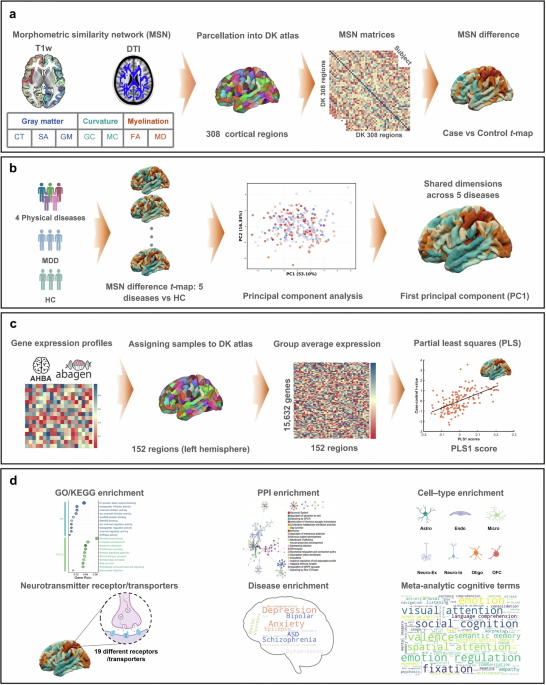
Major depressive disorder (MDD) is highly comorbid with physical diseases, suggesting shared neurobiological mechanisms. However, the common structural and molecular substrates underlying this comorbidity remain poorly understood. We analyzed multimodal MRI data from 577 patients (MDD, asthma, fibromyalgia, gastroesophageal reflux disease, type 2 diabetes) and 275 healthy controls, constructed individual morphometric similarity networks (MSN) to identify shared cortical alterations, and applied principal component analysis with multiscale molecular annotation (transcriptomic, cell-type, neurotransmitter, and cognitive mapping) to characterize underlying mechanisms.
All patient groups exhibited regional MSN abnormalities. A shared MSN pattern emerged, featuring increased similarity in visual and somatomotor regions and decreased similarity in ventral attention, limbic, and default mode networks, and was replicated in independent cohorts. This pattern was significantly associated with spatial gene expression enriched for synaptic signaling, membrane potential regulation, and neuronal architecture, with predominant expression in excitatory/inhibitory neurons and astrocytes.
It further mapped onto specific neurotransmitter systems, with exploratory cognitive decoding suggesting possible relevance to emotion and social cognition. Related genes overlapped with known risk loci for Alzheimer’s disease and bipolar disorder. These findings identify a robust across diseases cortical MSN phenotype linked to convergent molecular and neurochemical correlates, offering a framework for studying shared vulnerability and transdiagnostic mechanisms across depression and physical diseases.
This is a preview of subscription content, access via your institution Receive 12 print issues and online access Prices may be subject to local taxes which are calculated during checkout Human gene expression data that support the findings of this study are available from the Allen Brain Atlas (https://human.brain-map.org/static/download). MDD-related genes from in situ hybridization (ISH) are available from the Allen Brain Atlas (http://help.brain-map.org/download/attachments/2818165/HBA_ISH_GeneList.pdf?version=1&modificationDate=1348783035873&api=v2). Dysregulated genes based on postmortem brain tissue mRNA measurements were obtained from the raw dataset of Gandal et al. (https://pmc.ncbi.nlm.nih.gov/articles/instance/5898828/bin/NIHMS955683-supplement-DataTableS1.xlsx).
Cell-type-specific gene lists derived from large-scale single-cell studies of the adult human cortex were accessed from the dataset of Seidlitz et al. (https://static-content.springer.com/esm/art%3A10.1038%2Fs41467-020-17051-5/MediaObjects/41467_2020_17051_MOESM8_ESM.xlsx). Pre-calculated meta-analytic activation maps relevant to cognition were obtained from the BrainStat toolbox (https://github.com/MICA-MNI/BrainStat). Neurotransmitter receptor density maps were downloaded using the neuromap toolbox (https://netneurolab.github.io/neuromaps/index.html).
Genes associated with common brain disorders were retrieved from the GeneCards database (https://www.genecards.org/). All data supporting the findings of this study are provided within the paper and its supplementary materials. Additional information is available from the corresponding author upon reasonable request.
Extract — continue reading at the source.