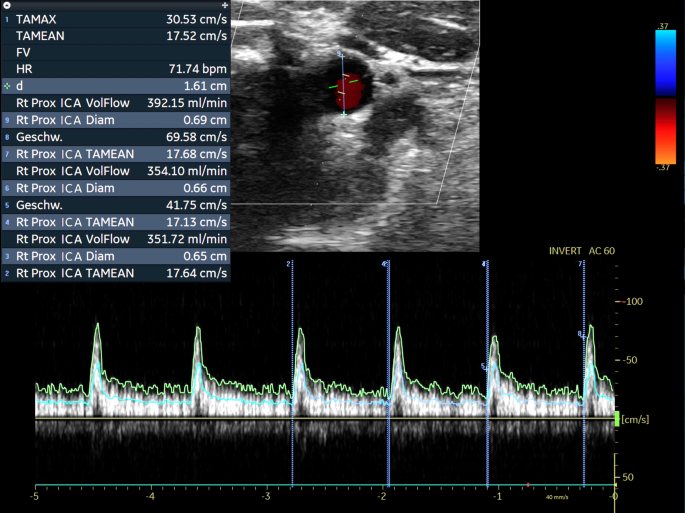
A number of studies have well described central cardiovascular changes caused by changing gravity levels as they occur e.g. during parabolic flight. However limited data exists describing the effect of microgravity on the cerebrovascular system and brain perfusion, which might heavily affect the intracranial pressure (ICP). In this study, performed on board the Airbus A310 ZeroG, the internal carotid artery (ICA) was examined for five consecutive parabolas during predefined windows at the start and end of each gravity phase (1G, 1.8G/pull-up, 0G, 1.8G/pull-out) by cardiac-gated B mode ultrasonography using a 7–12 MHz linear transducer.
ICA diameter and Doppler-derived velocity were recorded during predefined windows, and estimated ICA flow volume was derived offline. Simultaneously heart rate (HR) was monitored. Data was assessed in the 1G condition pre parabola and at the start and end of each 1.8G and 0G phase.
A lab-based study was administered where participants repeatedly changed between a seated and six-degree head down tilt (HDT) position for 20 s. During parabolic flight, HR increased during the two hypergravity phases and decreased back to 1G baseline in the weightlessness phase of the parabola. Blood flow velocity and flow volume showed a clear decrease in the first 1.8 hypergravity phase but returned to 1G baseline in the microgravity phase.
Different results were obtained by changing from a seated to a 6°HDT position, resulting in an increase in ICA diameter, flow velocity and flow volume. The present findings do not support a significant increase in extracranial ICA inflow during short periods of weightlessness, and that MCA velocity changes may not necessarily indicate increased cerebral blood flow volume. Lately, there has been an increased interest in the adaptation of the central nervous system (CNS) to prolonged weightlessness, triggered by the Space Flight Associated Neuro-ocular Syndrome (SANS)1.
One contributing factor could be a permanently 24/7 elevated intracranial pressure (ICP)2,3 caused by a redistribution of blood flow to the brain. Unfortunately, the role of an increased blood flow to the brain during microgravity has not been addressed sufficiently yet. In a first experiment by Schneider et al. (2013), using Near Infrared Spectroscopy (NIRS), it was shown that the concentration of oxygenized haemoglobin is increased in the brain during weightlessness.
One of the central findings of this study was, that the cardiovascular system cannot be regarded as a closed system, and changes in gravity forces are not simply accompanied by a redistribution of blood volume, but more subtle changes connected are assumed to occur4. A limitation of the NIRS method is that it only allows to assess local hemoglobin concentration and saturation but not true in- and out- flow, which seems to be the crucial parameter. To specifically understand blood flow within the brain the use of Transcranial Doppler was proposed to reveal further details.
Extract — continue reading at the source.