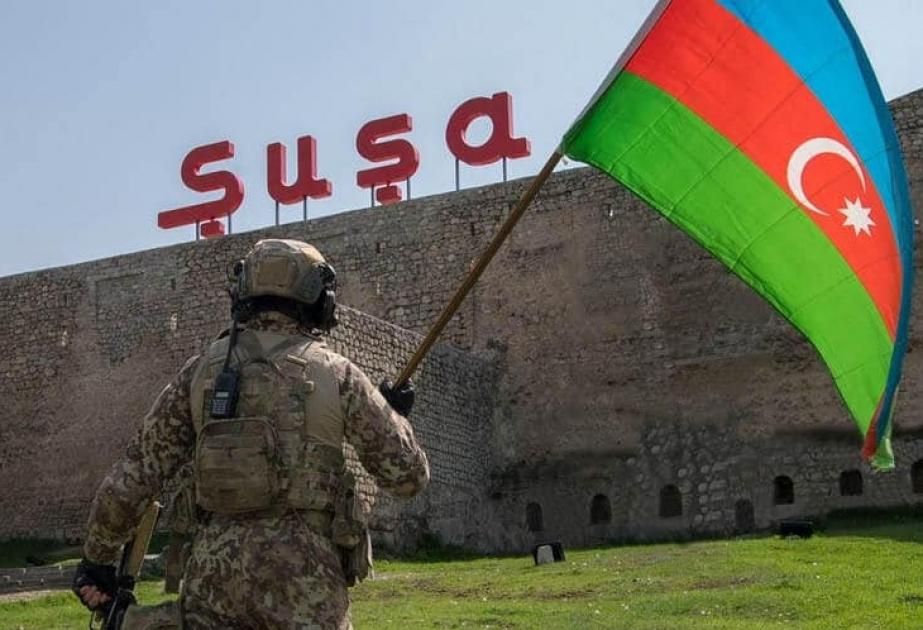
There are cities whose significance extends far beyond their geographical boundaries. Their identity becomes inseparable from the history of a nation, their architecture carries the memory of generations, and their geographical position shapes the political and military calculations of entire regions. Shusha represents precisely such a city for Azerbaijan.
Rising above the Karabakh mountains, surrounded by formidable cliffs and carrying centuries of Azerbaijani cultural heritage, Shusha has occupied a distinctive place in the country's historical consciousness. Its liberation on November 8, 2020, therefore represented far more than a territorial achievement. It transformed the military dynamics of the Second Karabakh War, strengthened Azerbaijan's negotiating position and contributed to a fundamental shift in the regional balance of power in the South Caucasus.
Founded in 1752 by Panahali Khan, Shusha emerged as the political and administrative centre of the Karabakh Khanate. Its elevated position, approximately 1,300–1,600 metres above sea level, provided natural defensive advantages and made the settlement an important fortress in the mountainous landscape of Karabakh. Over subsequent generations, the city developed into one of the most prominent centres of Azerbaijani intellectual, artistic and political life.
Its historical importance gradually acquired a cultural dimension that reached far beyond the borders of the Karabakh region. Shusha became a birthplace of musical excellence, literary achievement and intellectual creativity. The city gave Azerbaijan such distinguished personalities as composer Uzeyir Hajibeyli, opera singer Bulbul, poetess Khurshidbanu Natavan and poet Molla Panah Vagif.
Its musical traditions contributed to the development of mugham, classical composition and Azerbaijani performing arts. Shusha consequently earned its reputation as the conservatory of the Caucasus, a description reflecting its extraordinary contribution to the region's cultural landscape. For Azerbaijan, therefore, Shusha represented a concentration of historical memory, national identity and cultural heritage.
Its occupation in May 1992 carried profound political and psychological consequences, while its liberation in November 2020 marked the restoration of Azerbaijani control over one of the country's most historically significant urban centres. The symbolic dimension of this achievement was immense, yet its strategic implications were equally consequential. The first major strategic advantage emerged from Shusha's geography.
Extract — continue reading at the source.