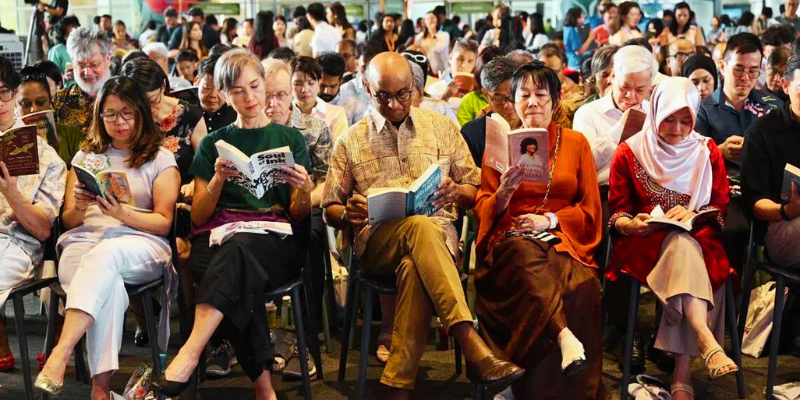
On September 6, Singapore started paying its citizens to read. As The Guardian reported, this scheme represents the city-state’s latest attempts to quash doomscrolling and protect children from the harms of social media. The National Library Board (NLB)—progenitor of the plan—hopes its “gamification strategy…will improve concentration, critical thinking and the imagination of Singaporeans.” And, of course, fire up the national book club.
The ReadSG pilot program is currently slated to run for five years. Here’s how the plan works, according to The Guardian’s Mark Saunokonoko: Under the scheme, readers accrue points that can be redeemed for a few cents. People will have to log 50 daily reading sessions on a government website to earn S$1 (80c).
A session of 15 minutes or more is rewarded with 20 virtual coins, with 1,000 coins needed for a dollar payment. One reading session is allowed daily. Not exactly Warbucks numbers, but you see the point.
Singapore has previously incentivized healthy eating and exercise, to evident success. NLB leaders have already compared this program to the widely successful 10,000 step challenge, which leapt across the pond from Japan to a Fitbit near you several years back. But will this pennies-for-pages plan result in a populace that genuinely likes to read?
Social scientists are split on the question. Evidence suggests that a short-term reward system—especially one that doesn’t pay meaningfully—is unlikely to effect a sticky habit. But if that reward mimics the dopamine effect so many of us get from scrolling, it is possible that the reading scheme will lead to less social media.
Katy Milkman, a professor at Penn’s Wharton business school, told The Guardian that the program might be especially useful for delinquent or lapsed readers. And if both personal pocket money and the sense of a job well done fail to motivate, the NLB has one more appeal: to altruism. A parallel program allows readers to apply their session-raised money to selected charities.
Extract — continue reading at the source.