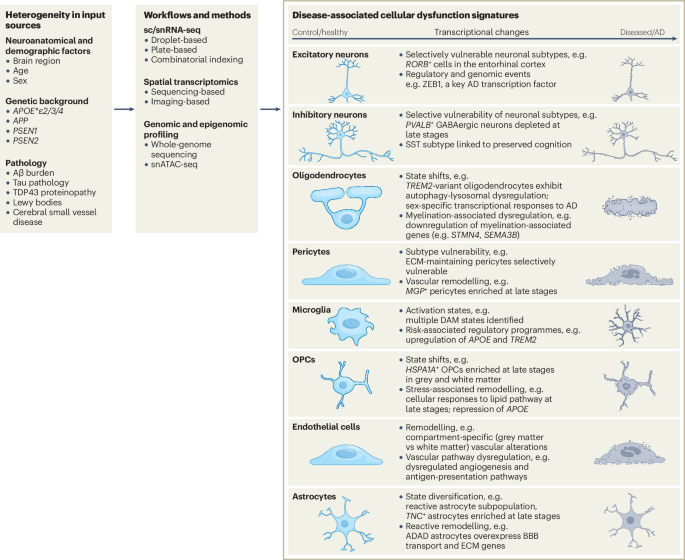
Alzheimer disease (AD) is defined neuropathologically by the presence of amyloid plaques and neurofibrillary tangles, yet these canonical lesions alone cannot account for its clinical, regional and cellular heterogeneity. AD is a multicellular, spatially organized disease shaped by the interactions of neurons, glia and vascular cells within distinct anatomical microenvironments. Single-cell and single-nucleus RNA sequencing have made it possible to dissect the transcriptional signatures of individual cell populations in the AD brain, revealing selective neuronal vulnerability, stage-dependent glial remodelling and widespread disruption of cell–cell communication networks, whereas spatial transcriptomics and multiplexed imaging have anchored these molecular changes to their tissue context.
Studies of defined populations, such as people with autosomal-dominant AD or Down syndrome-associated AD, and of the oldest-old cohorts help disentangle the molecular changes that are causal drivers from those that are downstream consequences. Across individuals, AD heterogeneity is further shaped by sex and ancestry, underscoring the need for broader representation of these factors in single-cell and spatial studies. These advances are also reshaping translational pipelines through multi-omic benchmarking of animal models and single-cell-based drug-repurposing strategies.
Thus, single-cell and spatial transcriptomics are redefining our understanding of AD heterogeneity and informing precision approaches to treatment. This is a preview of subscription content, access via your institution Access Nature and 54 other Nature Portfolio journals Get Nature+, our best-value online-access subscription Receive 12 print issues and online access Prices may be subject to local taxes which are calculated during checkout Hebert, L. E., Weuve, J., Scherr, P.
Alzheimer disease in the United States (2010–2050) estimated using the 2010 census. Neurology 80, 1778–1783 https://doi.org/10.1212/WNL.0b013e31828726f5 (2013). Article PubMed PubMed Central Google Scholar Chen, S. et al.
The global macroeconomic burden of Alzheimer’s disease and other dementias: estimates and projections for 152 countries or territories. Health 12, e1534–e1543 https://doi.org/10.1016/S2214-109X(24)00264-X (2024). [No authors listed] 2024 Alzheimer’s disease facts and figures. Alzheimers Dement. 20, 3708–3821 https://doi.org/10.1002/alz.13809 (2024).
III Alzheimer’s disease and the amyloid-β peptide. Alzheimers Dis. 19, 311–323 https://doi.org/10.3233/JAD-2010-1221 (2010). Article CAS PubMed PubMed Central Google Scholar Braak, H. & Braak, E.
Extract — continue reading at the source.


