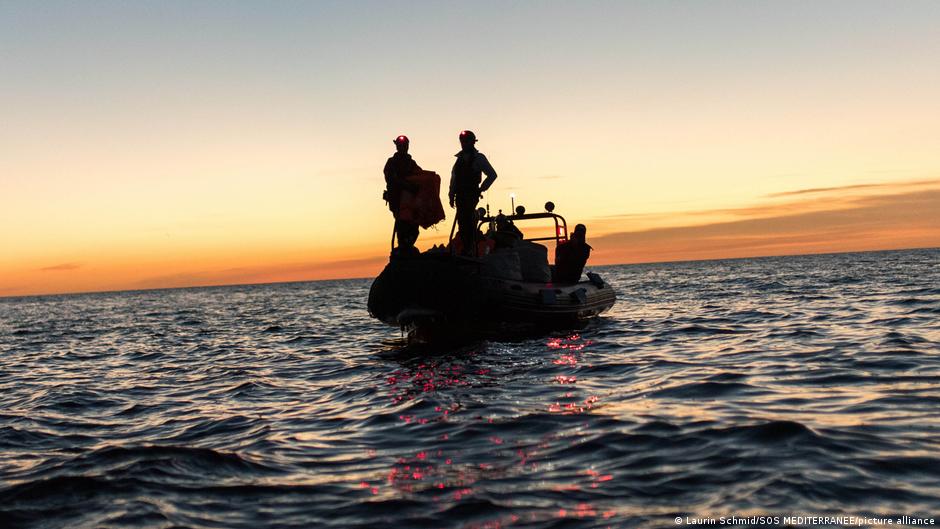
This year, almost 20,000 people have already tried to make the perilous crossing from Libya in north Africa to the Greek island of Crete. The route, which runs from the east coast of Libya to Greece, has become an increasingly significant corridor for irregular migration into Europe, Greek daily Kathimerini recently reported. On Oct. 20 alone, Greek authorities registered 710 people in 14 boats.
Hundreds more arrived the next day. Many of the boats depart from areas around Tobruk, a port city on Libya's eastern Mediterranean coast. According to Kathimerini, migrants pay as much as $4,000 (€3,600) for the crossing, which takes around a day and a half.
This particular route is becoming more popular in part because of crackdowns on alternative passages. After eastern Libyan armed forces acted against people smugglers heading for Italy in 2023, the smuggling networks changed their methods, using smaller boats and sailing them towards Crete instead. According to the Global Initiative Against Transnational Organized Crime, a think tank based in Switzerland, other groups have since entered the people smuggling business too, including those who previously mostly moved goods, vehicles or drugs.
Human trafficking in Libya is closely connected with what is known as the "conflict economy." This sees armed actors gaining economic resources and political influence by controlling informal markets and transport routes. It also sees local power brokers using measures against smuggling to obtain financial or political support for themselves. To view this video please enable JavaScript, and consider upgrading to a web browser that supports HTML5 video "Conflict and subsequent instability in Libya have created a fertile environment for migrant smuggling and TIP [trafficking in persons] activities to develop, in turn leading to the growth of smuggling in other locations along an established route," researchers at British think tank Chatham House wrote, after looking in depth at three different transit hubs across Libya.
"This has led to an increase in the number of migrants entering Libya and the expansion of Libya's conflict economy." "It remains the case that an entire business has developed around smuggling routes, regardless of whether that [smuggling] involves weapons, goods, people or drugs," Hager Ali, a researcher at the German Institute for Global and Area Studies, or GIGA, told DW. If there are already contacts, transportation and security arrangements in place, then these can also be used for illegal activities like people trafficking, Ali said. Since 2014, Libya has been split into two.
In the west, a United Nations-backed administration is based in Tripol; and in the east, in Tobruk, the second Libyan leadership is backed by former warlord-turned-politician Khalifa Haftar. Haftar has managed to consolidate control over various armed militias, ruling with an iron fist. His sons also hold important positions.
Extract — continue reading at the source.