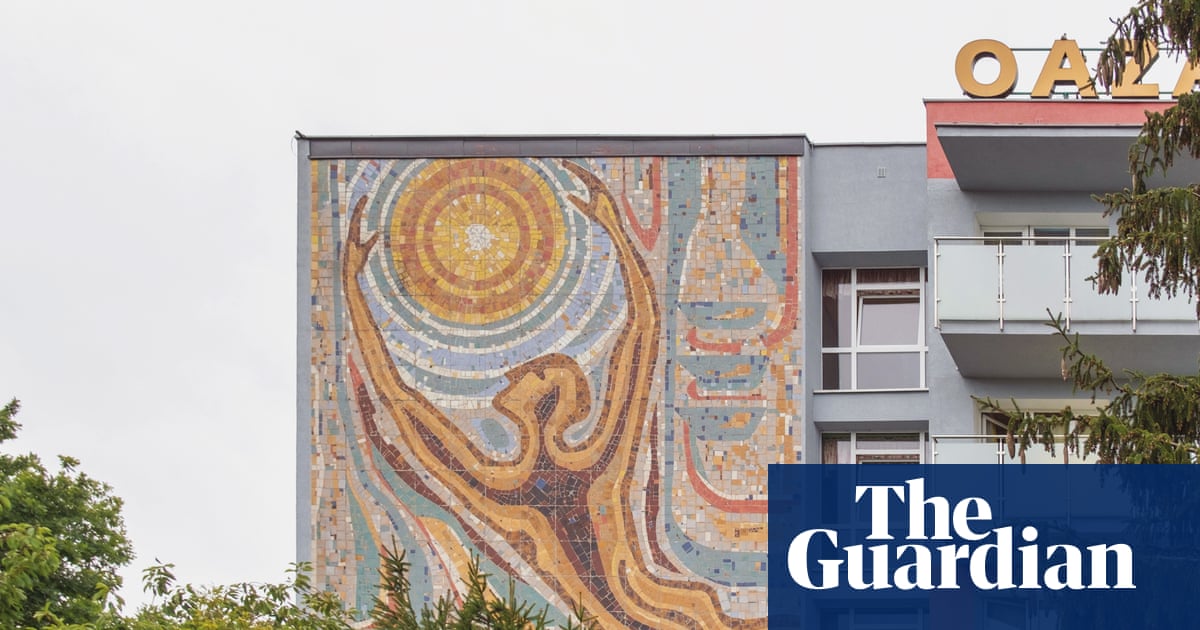
Socialist Hotels is the first photography book to focus solely on the architecture of hospitality in Eastern Europe and the post-Soviet landscape. These state-constructed buildings were used by visiting government workers and ordinary citizens. Today they are a fascinating legacy of a social and cultural idiosyncrasy.
Designed in 1970 by Valentina Pistoli (1928-93), Albania’s first female architect, the Hotel Skampa was part of the state-run _Turizmi_ hotel network. Pistoli was one of Albania’s most renowned architects, known for many landmark projects, including the Hotel Tirana and the Palace of Culture in Durrës. This original interior shows the design of the rooms at the time of the hotel’s opening in 1979.
Conceived as a showcase of openness to the west, Hotel Cosmos combined domestic expertise with French technology and international hotel standards for the 1980 Moscow Olympics. With 1,777 rooms, it was the largest hotel complex in the USSR. The square was renamed Place Charles-de-Gaulle in 1990, and the statue visible from the window was unveiled in 2005 by Vladimir Putin and Jacques Chirac.
Designed by Karel Hubáček (1924-2011) and completed in 1973, Ještěd rises 94 metres above its 1,012-metre summit, combining a mountain hotel, restaurant and television transmitter within a single hyperboloid form. Its interiors and bespoke furnishings were conceived by Otakar Binar (1931-2024), with artists Stanislav Libenský (1921-2002) and Jaroslava Brychtová (1924-2020) contributing to the design. A landmark of post-war Czech architecture, it has been included on the Czech Republic’s Unesco tentative list since 2007.
Completed in 1972 as the city’s first skyscraper, the hotel had more than 400 rooms and 23 floors, but the lift only went as far as the 22nd. That’s because the 23rd floor was a KGB listening centre with a direct line to Moscow, used to spy on the guests who included foreign business people, journalists and diplomats as well as tourists. In the summer of 1991, as the Soviet Union collapsed, the hotel’s KGB agents fled, leaving behind a mass of papers and listening devices.
These lay undiscovered until 1994 when the hotel was sold and renovated. spended ceiling at Hotel Slovakia, seen here in orange in the present breakfast room, has survived in several other spaces, where it appears in different colours. Its modular design and integrated lighting were conceived as an integral part of the interiors, lending the rooms a distinctive and subtly futuristic character for their time. The Sevan Writers’ Resort brings together two distinct moments of Soviet modernism: the Bauhaus-influenced residential building of the 1930s and the sculptural restaurant and lounge, completed in 1965 and nicknamed ‘Baby Whale’ for its distinctive form.
Extract — continue reading at the source.